


Can You Freeze Olive Oil? What Happens and How to Store It
Can you freeze olive oil without ruining it? Yes, but freezing is rarely the best choice for a bottle you use regularly. If you’ve opened a bottle and found it cloudy or thick after a spell in the cold, that change can be unsettling. Olive oil may turn cloudy or firm as its natural components respond differently to low temperatures. That change in texture does not, by itself, mean the oil has spoiled.
For most home cooks, a cool, dark place is more practical than the freezer. Freezing may suit a portion you won’t use soon, but it makes the oil less convenient to pour and use. The key is to choose storage around how much oil you have, how quickly you’ll use it and what works in your kitchen.
This article explains why olive oil changes in the cold, how pantry, fridge and freezer storage compare, and how to freeze and thaw a portion with less fuss. You’ll also learn why a cloudy bottle is not a reliable way to judge quality.
Key Takeaways
- If you’re deciding can you freeze olive oil, consider how much you have, how soon you’ll use it and whether freezer storage suits your routine.
- Compare pantry, fridge and freezer storage by convenience. Cold temperatures can change the oil’s texture, but appearance alone does not establish its quality.
- For oil you reach for regularly, choose storage that keeps it easy to pour and use.
- If you freeze surplus, use a freezer-suitable container, divide the oil into practical portions and thaw it gradually at room temperature.
- After thawing, assess the oil’s aroma and flavour rather than judging it by appearance alone.
Can You Freeze Olive Oil? The Short Answer for Home Cooks
Yes, you can freeze olive oil, but it’s usually unnecessary for a bottle you use regularly. The more practical choice depends on how much oil you have, how soon you plan to use it and whether you have a cool, dark place for everyday storage. Freezing can make sense for surplus, but it adds a thawing step before the oil is ready to pour.
Olive oil is a mixture of fats and other naturally occurring components, which helps explain why it can change in the cold. For an overview of its makeup and storage, see Olive oil composition and storage. A bottle that turns cloudy, thick or partly solid after chilling has changed in appearance or texture because of the temperature. That change alone doesn’t mean the oil has spoiled.
When freezing olive oil might make sense
Freezing may be worth considering if you have more oil than you expect to use soon, or a portion left from a larger supply. Before freezing it, think about when you’ll use it and how you’ll thaw it. Setting aside a small portion for later can be more convenient than freezing an entire bottle you reach for every day. Keep in mind that flavour after freezing may vary, so don’t assume every fresh sensory note will be unchanged.
That’s different from repeatedly chilling the bottle you use each day. Frequent temperature changes can make the oil less convenient, particularly if it thickens or becomes difficult to pour. Keep your routine simple: store the everyday portion where it’s easy to use, and consider freezing only surplus that you don’t expect to need soon.
What freezing does not prove about olive oil
A cloudy or thickened bottle isn’t a dependable quality test. Cold-related changes don’t establish an oil’s freshness, origin, production practices or overall quality. Freezing doesn’t improve oil or guarantee a longer usable life, either. Assessing quality requires more than looking at how the oil behaves in the cold.
Freezing causes a physical change, but that doesn’t guarantee every oil will return with precisely the same aroma and flavour. Treat freezing as a storage option, not a way to enhance oil or verify its quality. When deciding whether to keep a surplus, consider the storage conditions you can maintain and how you expect to use it.
For most home cooks, the goal is simple: keep the oil convenient to use and enjoy its flavour. If a bottle has turned cloudy in the cold, let it return to room temperature before judging its appearance. The next sections compare pantry, refrigerator and freezer storage, then explain how to handle oil you choose to freeze.
Why Olive Oil Turns Cloudy or Thick When It Gets Cold
A bottle’s response to the refrigerator can look like a simple pass-or-fail test, but it isn’t. The so-called “fridge test” claims that genuine extra virgin olive oil will solidify while lower-quality or adulterated oil won’t. That conclusion doesn’t follow from what you see in the bottle. Olive oil composition varies, so different oils can respond differently under the same conditions. For background on what olive oil contains, see Olive oil composition and storage.
Why cold changes olive oil’s appearance
There’s no universal refrigerator result to look for. One oil might become cloudy while another remains clearer. That contrast doesn’t establish which oil is fresher or better. The visible response is a physical characteristic, not a certificate of origin or proof of how an oil was produced. A household fridge is also not a controlled testing environment, so one observation can’t support a dependable comparison.
If a bottle looks different after chilling, its appearance tells you about its response to cold, not whether it meets a quality category. The term “extra virgin” refers to standards beyond how the oil behaves in a refrigerator. A more useful assessment considers available product information and the oil’s aroma and taste when it’s ready to use.
Why the fridge test can’t grade extra virgin olive oil
The UC Davis Olive Center has debunked the idea that refrigerator solidification can reliably identify olive oil purity. Refined olive oil can also solidify at refrigerator temperatures, so solidification isn’t exclusive to extra virgin oil. Conversely, a sample that looks different doesn’t prove adulteration. The test can’t distinguish oils reliably enough to act as an authenticity check.
Nor does the test tell you whether an oil is fresh. A bottle’s response to cold doesn’t reveal its harvest date, handling history or flavour condition. For a more grounded choice, consider available quality information and notice the oil’s aroma and taste when it’s ready to use. If you’re comparing oils by character, explore extra virgin olive oils with those qualities in mind.
In short, don’t use a refrigerator as a grading tool. A clear or solidified sample can’t settle questions of authenticity, freshness or overall quality. Treat the fridge test as a myth, not a shortcut to knowing what’s in the bottle.
Freezer, Fridge, or Pantry: Which Olive Oil Storage Choice Makes Sense?
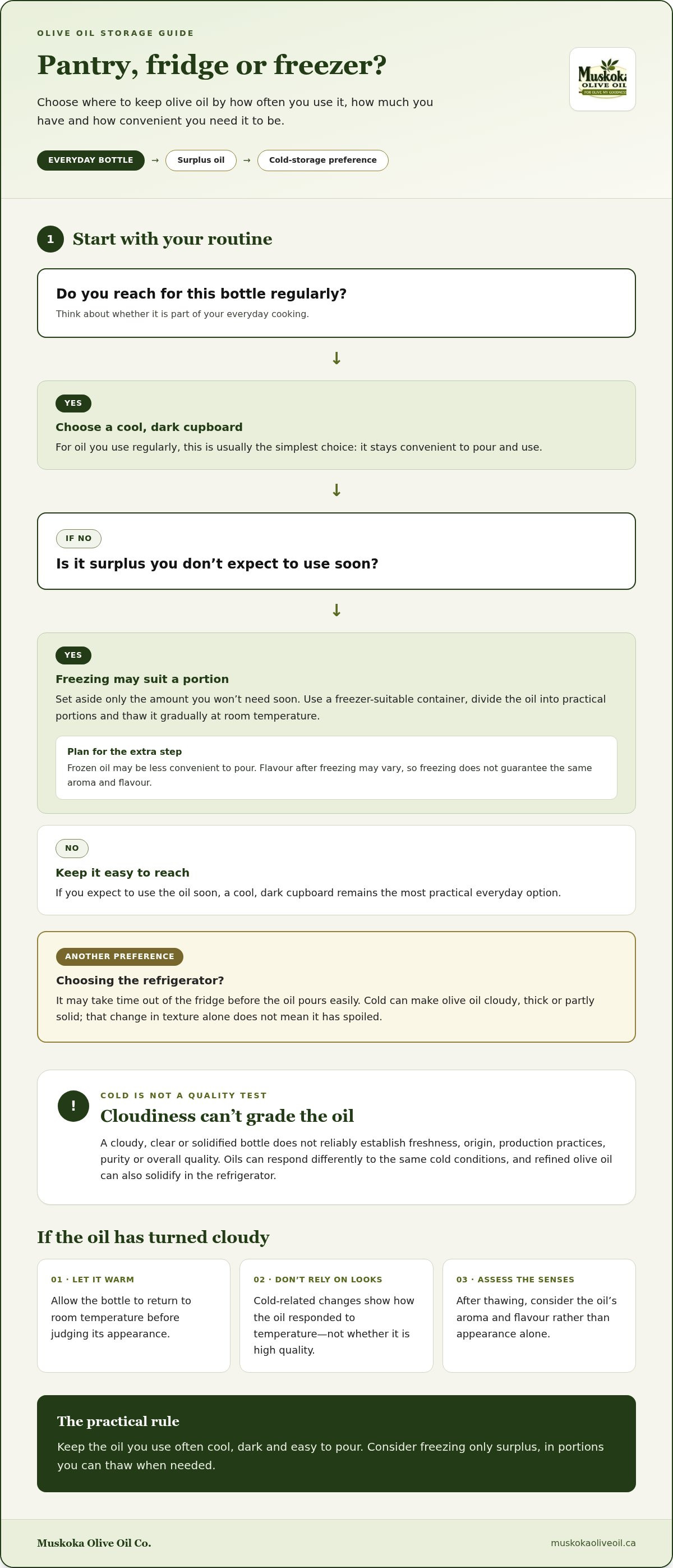
Choose storage based on how often you reach for the oil, how much you have and what space is available. For a bottle used in everyday cooking, a cool, dark cupboard is usually the simplest fit. Colder storage may suit a portion you won’t need soon, but it adds a step before the oil is ready to pour.
| Storage choice | Convenience | Practical fit |
|---|---|---|
| Pantry or cupboard | Ready to use during everyday cooking | A bottle you reach for regularly |
| Refrigerator | May need time out of the fridge before pouring easily | A specific storage preference, with less emphasis on quick access |
| Freezer | Requires planning and thawing before use | A portion of surplus you don’t expect to use soon |
Everyday storage for a bottle in regular use
Keep the bottle in a cupboard or pantry away from direct sunlight and sources of heat. A shelf beside the stove might seem handy, but repeated warmth isn’t ideal for storage. After pouring, close the cap promptly and put the bottle back in its chosen spot. Limiting exposure to light, heat and air helps protect the oil’s character while keeping it convenient to use.
Think about your kitchen routine. If you reach for the bottle to make a quick dressing, sauté vegetables or finish a dish, easy access matters. A shaded cupboard near your food-preparation area keeps it within reach without leaving it on a bright counter or beside a hot appliance.
When refrigeration or freezing is being considered
Refrigeration and freezing are less convenient for oil you use throughout the day because you may need to wait for it to pour easily. Freezing is an optional choice for surplus, not a routine quality test. Consider whether you’ll use the portion before choosing colder storage, and follow any directions supplied for that particular product.
For example, if you cook with olive oil most evenings but have an extra portion set aside, keep the everyday bottle accessible and store only the surplus separately. That way, you won’t have to wait for the oil to thaw whenever you cook. There’s no single storage choice for every household; the best fit depends on your available space and how you use the oil.
If you’re choosing an oil for regular cooking, explore extra virgin olive oils with your preferred flavours and everyday dishes in mind. Then choose a storage spot that protects the bottle from light and heat while keeping it convenient for the meals you make.
How to Freeze and Thaw Olive Oil with Less Fuss
If you’ve decided freezing suits an unused portion, a little preparation can make it easier to handle later. Use a container made for freezer storage, and check any storage directions supplied for the particular oil. These steps can help keep portions practical, though they can’t guarantee that every oil or container will behave the same way.
Prepare portions before placing oil in the freezer
Choose a clean, freezer-suitable container with a secure lid. Don’t assume an ordinary glass bottle can go straight into the freezer, since not every container is designed for those conditions. Divide surplus oil into portions that match how you expect to use it. Smaller portions can help you avoid thawing more oil than a recipe or meal requires.
- Pick a suitable container. Use one intended for freezer storage, and make sure it’s clean and dry before filling.
- Leave room at the top. Don’t fill the container to the brim. Allow headspace for the oil to expand as it freezes, helping reduce pressure on the container and the chance of spills.
- Seal and label it. Close the lid securely to limit leaks and unnecessary air exposure. Add the contents and the date so you can identify the portion later. A label is a useful record, not a storage-duration rule.
- Freeze only what you mean to store. Keep the bottle used for regular cooking separate from the surplus portion, rather than moving the daily-use bottle in and out of the freezer.
Thaw gently and assess before cooking
Remove a portion from the freezer and let it warm gradually while still sealed. Keep it at room temperature until it’s easier to pour, and avoid rushing the process with direct heat. Depending on the oil and how cold it became, it may stay cloudy or thick for a while as it warms. Give it time before assessing its aroma or appearance.
Once it has warmed, open the container and notice the aroma and flavour before using it, especially if you plan to finish a dish with the oil. Appearance alone can’t establish freshness or quality. If the oil’s sensory character seems different from what you expect, consider its storage history and any instructions provided for it rather than assuming the texture change explains everything.
So, can you freeze olive oil and make the process practical? Yes. If you’re storing surplus, portion it carefully, use a suitable container and thaw it without rushing. Freezing isn’t essential for everyday cooking, and it can’t promise that every flavour note will remain unchanged. If you’re also choosing an oil for your kitchen, explore extra virgin olive oils with flavour and freshness in mind.
Keep Olive Oil Enjoyable: Freshness, Flavour, and Your Next Choice
The point of deciding whether can you freeze olive oil isn’t simply to make it solid or liquid again. It’s to enjoy the oil’s flavour in the way you intended. Freezing can be an option for surplus, but storage should suit how much your household uses and how often you cook with it. Keeping a manageable amount on hand can be more practical than setting aside more oil than you’re likely to use.
What to notice after thawing
Let the oil warm before you assess it. Check whether it has returned to a consistency that’s easy to pour, then notice its aroma and, if appropriate, taste a small amount. Temporary cloudiness or thickness can linger while it warms, so don’t judge the oil by appearance alone. Sensory differences, if present, may be subtle. Avoid assuming that freezing has either preserved every note or ruined the flavour.
Compare the aroma and taste with what you remember, while keeping in mind that impressions can be subjective. If the oil seems noticeably different, consider its overall storage history as well as the time spent frozen. Follow any storage directions supplied for the particular oil. No single visual check can establish freshness, quality or suitability for use.
Choose olive oil for the way you cook
How quickly your household uses a bottle can guide both the amount you keep on hand and your storage choice. If you finish oil steadily, convenient everyday storage may make more sense than freezing. If you have surplus, portioning it before freezing can help you avoid thawing more than you need. There’s no need to freeze every bottle as a routine measure.
Flavour preference matters, too. Extra virgin olive oils have distinctive characters, while infused olive oils bring added flavour suited to different dishes and tastes. Choosing an oil you’ll enjoy using regularly helps keep storage decisions grounded in real cooking habits. For a closer look at qualities to consider, explore an extra virgin olive oil quality guide alongside information about harvest, freshness and flavour.
For your next bottle, consider the dishes you make most and choose an amount your household can comfortably use. If you’d like to compare flavour profiles and find an oil that suits your cooking, browse this extra virgin olive oil selection. Thoughtful storage helps keep the focus where it belongs: on the aroma and flavour you enjoy bringing to the table.
Make Your Next Bottle a More Enjoyable Choice
Storage is part of enjoying olive oil, but so is choosing a flavour you’ll look forward to using. Let the way you cook guide your next choice: a finishing oil can bring a different character to a dish than an oil you reach for in everyday cooking. Paying attention to aroma, taste and harvest information can make selecting your next bottle more rewarding.
If you’ve wondered, “can you freeze olive oil,” the answer can help you make a practical decision, but it doesn’t need to define your routine. Choose storage that suits your household, then focus on the flavour you want at the table.
Muskoka Olive Oil Co. values freshness and olive oil education, with extra virgin and infused oils to explore. Explore extra virgin olive oils and find a flavour to inspire your next meal. Enjoy the process, one thoughtful pour at a time.
Frequently Asked Questions
Can you freeze olive oil in an ice cube tray?
Yes, if the tray is clean and suitable for freezer use. Small portions can be handy when a recipe calls for a modest amount, such as dressing vegetables before roasting. Once the oil is firm enough to handle, transfer the portions to a sealed, freezer-suitable container to free up the tray. Label it with the contents and date, and follow any storage directions supplied for your oil.
Does frozen olive oil go bad?
Freezing alone doesn’t establish whether olive oil has gone bad, and it can’t guarantee that the oil will stay fresh indefinitely. Its condition depends on factors such as its freshness before freezing and how it was stored. After thawing, notice the aroma and taste as well as whether it pours as expected. Don’t rely on cloudiness or firmness alone to decide its quality.
Can you freeze infused olive oil?
For infused olive oil, follow the storage directions provided for the product. Ingredients and formulations can vary, so don’t assume that advice for plain olive oil applies to every infused oil. Freezing can change texture, and the finished oil may not behave exactly like plain olive oil. Use the product’s storage instructions to guide your choice.
How long does olive oil take to thaw?
There isn’t one reliable thawing time for every portion. It depends on the amount of oil, the container and how solid the oil became. A small portion may soften sooner than a full container, but let it warm naturally while sealed rather than planning around a fixed time. Check periodically, and wait until it’s easy to pour before opening and using it.
Can you use olive oil while it is still frozen?
You can use it if you can remove the amount needed, but solid or very thick oil may be awkward to measure and distribute evenly. For a cold dressing, for example, letting it soften first can make it easier to blend with other ingredients. If cooking, measure what you need once it’s workable rather than trying to force a utensil into a rigid container.
Can olive oil be refrozen after it has thawed?
There isn’t enough general guidance to recommend refreezing olive oil after it has thawed. If you’re planning to freeze a portion, divide it beforehand into an amount you expect to use at once. If it has already thawed, follow the storage directions for that product and don’t treat refreezing as a way to restore freshness.
Why is my olive oil cloudy after being in the fridge?
Olive oil can become cloudy in the fridge as some of its natural components respond to the cold. The appearance varies, and the oil may clear as it warms. Cloudiness alone doesn’t tell you whether the oil is fresh, authentic or high quality. Let it return to room temperature, then assess its aroma and flavour rather than using the fridge response as a test.
Leave a comment