


Olive Oil Terroir: How Place Shapes the Flavour in Your Bottle
What if two oils made from the same olive variety tasted entirely different? That’s where olive oil terroir comes in: an oil’s character reflects not just where olives grow, but how place, variety, season and production choices come together. The idea can sound abstract, especially when a bottle’s origin doesn’t immediately tell you what to expect in the glass.
Terroir doesn’t mean every oil from one region tastes alike, and it isn’t a shortcut for judging quality. Climate, soil and landscape influence how olives grow, while cultivar and harvest timing also contribute to aroma, bitterness and a peppery finish. The result is a combination of place, olive, season and human decisions.
This article explains how to distinguish terroir from variety, harvest and quality, and how to explore those differences through a simple tasting. Notice whether an oil seems grassy, ripe, delicate or robust, then compare your impressions with its origin and harvest details. You’ll get a more useful sense of provenance and discover which oils you enjoy.
Key Takeaways
- Olive oil terroir reflects the interaction of growing conditions and human choices, not a single flavour associated with a place.
- Cultivar, harvest year and quality describe different things. Origin alone doesn’t guarantee an exceptional oil.
- A simple tasting sequence can help you notice an oil’s aroma, taste and finish, then put your impressions into words.
- Comparing extra virgin olive oils from different growing regions is a practical way to explore their sensory differences.
- Northern and Southern Hemisphere harvests provide useful context when comparing oils and their seasons.
What Does Olive Oil Terroir Mean? Start with Place, Not a Flavour Label
Terroir describes the environmental conditions and human decisions that interact to shape an agricultural product. For olive oil, the setting where olives grow is part of the story, but not the whole story. A place name offers useful context, not a fixed prediction of flavour.
Wine offers a familiar comparison: growing conditions and production choices help explain why wines differ. Olive oil has its own context, shaped by cultivation, harvest and milling. Thinking about olive oil terroir gives curious cooks a way to consider why extra virgin oils vary, without assuming that a country or region has only one recognizable taste. For a broader explanation of the term, see What is Terroir?
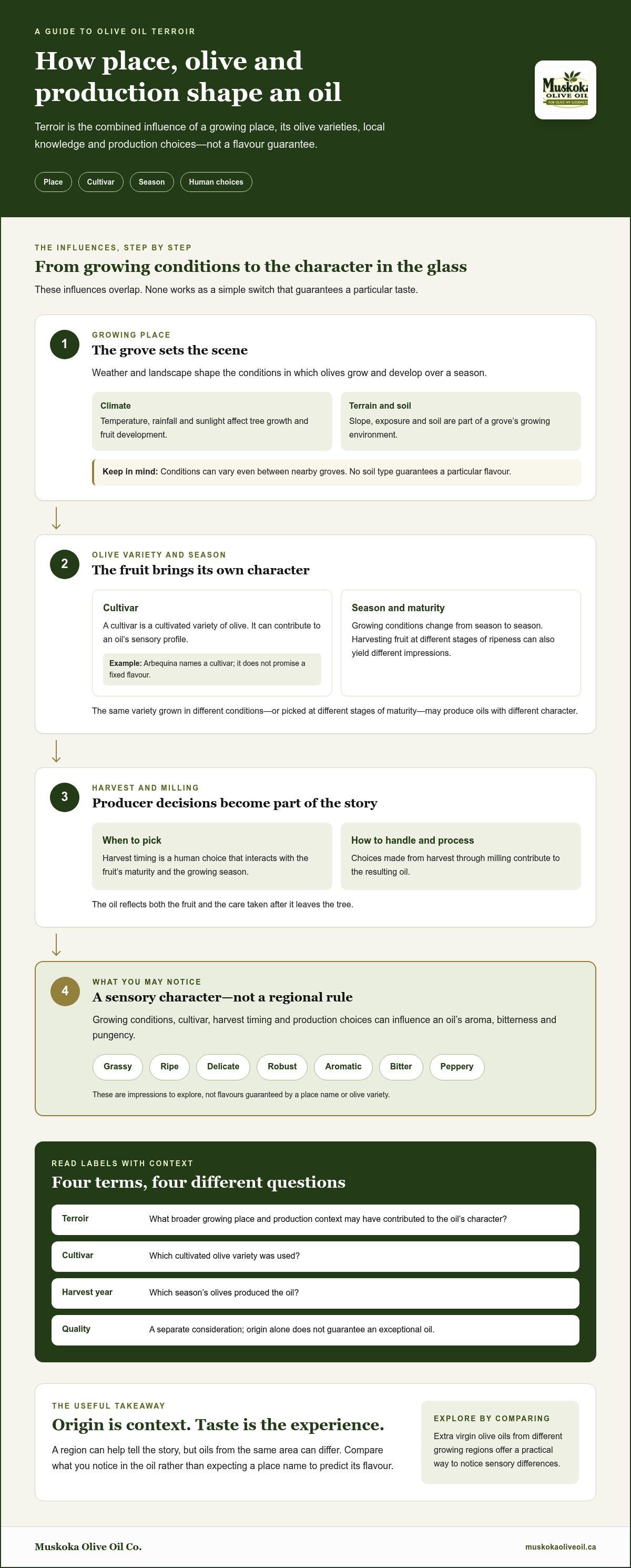
A visual example can help bring the idea of place and olive oil together:
What does terroir include beyond a place name?
A country or region on a label identifies origin at a broad level. Terroir invites a more layered question: what growing conditions, olive varieties, local knowledge and production decisions contributed to this particular oil? These influences interact rather than acting as separate switches that create a predictable flavour.
Even within one region, groves can have different growing conditions, and producers may use different cultivars or make different choices about harvest and processing. Two oils from the same area need not taste alike. A place name alone can’t tell you whether an oil will seem mild, robust, grassy or ripe. Those are impressions to explore in the oil itself.
Why can two extra virgin olive oils taste different?
An oil’s sensory character can reflect several influences at once. Olive variety contributes its own tendencies, while growing conditions and harvest timing also play a role. Oils made from different cultivars may have distinct aromas or levels of bitterness and pungency. Fruit harvested at different stages of ripeness can also yield oils with different impressions. These are possible influences, not guaranteed formulas.
Olive oil terroir is the combined influence of a growing place, its olive varieties, local knowledge and production choices on the character of an oil. It’s a useful lens, not a quality grade or a promise that an oil will taste a certain way. When exploring extra virgin oils from different origins, compare what you notice rather than matching a region to a flavour label. The extra virgin olive oils from different growing regions offer a practical starting point for that comparison.
How Climate, Cultivars and Production Choices Shape Olive Oil Terroir
An olive’s journey begins in a particular growing environment, but a map doesn’t dictate its final character. Weather patterns, terrain, soil, cultivar and decisions made at harvest and in the mill can all contribute. Their effects overlap, so it’s more useful to think of them as influences than as fixed rules, such as “this soil makes peppery oil.”
How do growing conditions influence olives?
Temperature, rainfall and sunlight affect how an olive tree grows and how its fruit develops over a season. Terrain matters too: slope and exposure can shape the conditions a grove experiences. Soil is part of the tree’s growing environment, but no soil type guarantees a particular flavour. These factors can vary within a named region, even between nearby groves.
Conditions also change from one growing season to another. Oils from the same place may therefore differ from year to year. A regional name provides a broad point of reference, while the particular grove and season add finer detail. That’s why broad claims that connect one region with a single taste can oversimplify what’s in the bottle.
Where do olive varieties and harvest decisions fit?
A cultivar is a cultivated variety of olive. Each cultivar has its own characteristics and can contribute to an oil’s sensory profile, but it doesn’t tell the whole story. Arbequina, for example, names a cultivar, not a guaranteed flavour description. The same variety grown in different conditions, or harvested at different stages of maturity, may yield oils with different character.
Harvest and milling bring human choices into the picture. Producers decide when to pick the fruit and how to handle it through processing. Those choices interact with the condition of the olives and the growing season. The resulting oil reflects both the fruit and the care taken after it leaves the tree.
An olive oil’s character emerges from the interplay of its growing environment, cultivar, season and the choices made from harvest through milling.
This is the practical value of olive oil terroir: it encourages you to treat origin as context, then stay curious about the oil itself. Rather than expecting a country or soil type to predict what you’ll taste, consider how several influences may have come together. Comparing oils from different growing regions makes those distinctions easier to explore. The extra virgin olive oils from varied origins offer a way to experience that range through tasting.
Olive Oil Terroir Compared with Variety, Vintage and Quality
These terms often appear together on an olive oil label or in a tasting conversation, but they answer different questions. Keeping them separate makes it easier to interpret origin claims without treating them as a scorecard.
- Terroir: What broader growing place and production context may have contributed to the oil’s character?
- Cultivar: What cultivated olive variety was used?
- Harvest year: Which season’s olives produced the oil?
- Quality: How well does the oil meet the relevant standards for its category, and how does it perform in sensory and freshness terms?
Is terroir the same as olive variety or harvest year?
No. A cultivar identifies the olive variety, while a harvest year points to the season in which its fruit was picked. Terroir offers a wider frame for understanding how a place and the ways people work within it may shape the oil.
Think of these as answers to three different questions: “Which olive?”, “Which season?” and “What growing and production context?” A producer may use the same cultivar in successive harvests, yet the oils can vary from year to year. The broader place and established practices remain relevant, but a particular season’s conditions and fruit can give that harvest its own character. A vintage is useful context, not a guarantee that one year’s oil will taste better than another’s.
Does terroir tell you whether an oil is high quality?
No. Terroir describes context; it isn’t a grade or guarantee of excellence. A prestigious-sounding place name can be meaningful, but it doesn’t establish how fresh an oil is, how it was handled, or whether it has the qualities expected of extra virgin olive oil. Provenance adds a layer to the story, not a substitute for assessing the oil.
For a practical comparison, consider the origin alongside harvest information and your own sensory impressions. Freshness matters because desirable aromas and flavours can diminish over time, so harvest context is worth considering as part of the picture. Origin storytelling cannot replace relevant quality information or what you notice when tasting.
This distinction helps avoid a common assumption: an oil from a celebrated region isn’t automatically superior to one from a less familiar origin. A well-made oil from either place may be worth exploring. The best choice for your kitchen depends on its quality and the flavours you enjoy. To explore oils while keeping origin and quality distinct, browse the ultra-premium extra virgin olive oil selection and compare their individual character.
How to Taste Olive Oil and Notice Its Sense of Place
Tasting is a simple way to discover how extra virgin olive oils differ, even though it can’t tell you exactly where an oil comes from. Set out small samples and compare them side by side if possible. Before reading labels or tasting notes, write down what you notice. Your first impressions are useful, personal observations, not a test you need to pass.
What should you notice when tasting extra virgin olive oil?
Use a clean glass or small cup for each oil. A neutral setting helps keep other aromas from taking over. You don’t need specialist equipment or elaborate vocabulary. Pay attention to what you smell, how the oil feels and tastes, and what lingers after you swallow.
- Notice the aroma. Smell the oil and jot down your first impression. Does it bring to mind fresh leaves, herbs, ripe fruit or something more delicate? You can simply call an aroma “green,” “fruity” or “mild.”
- Taste a small sample. Take a little oil and let it move across your palate. Notice its fruitiness, then whether you sense bitterness. Bitterness can be a normal feature of extra virgin olive oil, but its presence alone doesn’t identify a region.
- Pay attention to the finish. After swallowing, notice any peppery or warming sensation at the back of your throat, and how long the flavours remain. Describe what you feel in your own words.
Compare one or two oils at a time. Taste both with attention to their aromas, then try them again and focus on bitterness or pungency. If you have useful label information, compare oils from different growing regions or oils from the same region with different harvest details. Where possible, change one point of comparison at a time. This makes it easier to identify what stands out, even though it can’t isolate every influence.
How can provenance help you explore flavour?
After recording your impressions, look at the label or any accompanying tasting notes. Origin, harvest and production information add context to what you’ve noticed, but descriptors are guides rather than rules. An oil described as grassy may not remind every taster of grass, and that impression doesn’t prove where the olives grew or which cultivar was used.
Sensory impressions are useful clues for comparing oils, not a test that can confirm their provenance. Tasting can reveal differences and help you discover what you enjoy; it can’t conclusively identify an oil’s origin. That’s the practical pleasure of exploring olive oil terroir: let the oil speak first, then use provenance as another part of its story.
Ready to put your tasting notes to work? Explore extra virgin olive oils from different growing regions and compare their aromas, tastes and finishes for yourself.
Explore Olive Oil Terroir Through Oils from Different Growing Regions
The most rewarding way to explore olive oil terroir is to taste oils from more than one growing region and notice how each expresses its own character. Extra virgin olive oils sourced from around the world give you origins to compare without requiring you to decide that one place or style is better than another.
Begin with curiosity rather than a checklist. Taste two oils in the same setting and note what you enjoy about each. One might seem more delicate to you, while another leaves a more pronounced impression. These are personal observations, not labels that need to fit a regional stereotype.
What can different harvest hemispheres add to your perspective?
Olives in the Northern and Southern Hemispheres grow through different seasonal cycles, so harvest context can help explain why oils from different origins may have been produced at different points in the calendar. Consider that information alongside what you smell and taste. Hemisphere alone doesn’t determine an oil’s freshness, quality or flavour, and it shouldn’t be used as a shortcut for ranking oils.
Harvest details can also help you make a fairer comparison. When tasting oils from different hemispheres, keep their harvest context in mind rather than assuming their seasons align. Then focus on the oils themselves: which aromas stand out, what flavours suit your palate, and which might work best in your cooking?
How can you continue exploring terroir at home?
Keep brief notes in a notebook or on your phone. Record an oil’s origin and harvest information when available, then add a few sensory impressions and a possible use. For instance, you might note that an oil’s character appeals to you with bread, or that you’d like to try it over vegetables. There’s no need for elaborate tasting language. A few honest words can help you remember what you liked when you compare oils again.
Over time, your notes may reveal preferences that matter more than a place name alone. You might find that you enjoy a particular degree of fruitiness or a lingering peppery finish, or that different oils suit different dishes. Use provenance as context, not a prediction. A regional label can prompt a question, while tasting helps you decide whether the oil is right for your table.
For more context on choosing and assessing extra virgin oils, explore the ultra-premium extra virgin olive oil selection. Compare oils from different growing regions, noticing their individual character and the ways you might enjoy them. Take your time and let each tasting sharpen your sense of what you love.
Let Your Curiosity Lead to the Next Tasting
Let olive oil terroir be an invitation to keep exploring, not a formula for predicting exactly what you’ll taste. The most meaningful discovery may be finding an oil whose character suits a meal you love, whether that’s a simple dip with bread or a finishing touch on dinner. Your palate is the guide; origin and harvest details add context without dictating your preference.
At Muskoka Olive Oil Co., freshness, quality, flavour and olive oil education are at the heart of exploring extra virgin oils. Explore extra virgin olive oils and find a new favourite to bring to your table.
Frequently Asked Questions
Can olive oil have terroir in the same way wine does?
Yes, though the comparison has limits. Both invite you to consider how origin relates to character, but olive oil is tasted as a fresh fruit juice, not assessed using wine’s full vocabulary or conventions. For a useful tasting, focus on the oil’s own aromas and sensations rather than borrowing assumptions about wine. The shared idea is a sense of place; the way you explore it differs.
Is olive oil terroir the same as a geographical indication?
No. A geographical indication is a formal designation tied to an origin and defined conditions for using its name. Terroir is a broader way of thinking about how a product’s place and making may be reflected in it. An origin printed on a bottle doesn’t automatically mean the oil has a geographical indication. If a designation appears, read its name and rules as additional provenance information.
Can an organic olive oil express terroir?
Yes. Organic status and terroir describe different things, so an oil can be both organic and expressive of its growing origin. An organic label may tell you about the production system, but it won’t tell you whether the oil tastes mild, robust or particularly fruity. Treat the organic claim as one piece of information, then use the oil’s origin, harvest details and your own preferences to guide your choice.
Does the olive variety matter more than the place where it grows?
There isn’t one answer that applies to every oil. To explore the role of variety, compare oils from different cultivars while keeping other known details as similar as possible, such as harvest context. Then try oils made from the same cultivar but from different origins. You may notice a contrast, but tasting is an exploration, not a controlled experiment that can isolate one influence perfectly.
Can you identify an olive oil’s origin by tasting it?
No, tasting isn’t a dependable way to name an oil’s origin. Try a blind comparison: have someone pour two samples without showing their labels, and write down what you notice before seeing where they came from. This can reduce the influence of expectations and help you describe your preferences more honestly. Afterward, use the label to learn the provenance rather than treating your tasting notes as proof.
Does olive oil terroir change from one harvest to another?
The way an origin is expressed can differ between harvests. If you compare oils from different years, note the harvest information and whether each bottle has been open for a different amount of time. That gives you a fairer tasting than comparing a newly opened oil with one that has been exposed to air for a while. Record your impressions by harvest so you can revisit the comparison later.
Is terroir a reliable way to choose a high-quality olive oil?
No. Use origin to guide exploration, not as your only buying test. Check the harvest information when it’s provided, choose an amount you expect to use while the oil is at its best, and store it away from light and heat after opening. If you can taste before buying, sample it plain and consider whether its flavour suits the dishes you make. Your preferred oil should work for your table.
Leave a comment