


Balsamic Vinegar Storage: Pantry Tips and Spoilage Signs
Balsamic vinegar belongs in a cool, dark pantry, not the refrigerator. For most bottles, the answer to whether you should refrigerate balsamic vinegar is no: its acidity helps preserve it, so refrigeration isn’t needed after opening. For best flavour, use opened balsamic within one to two years, though it may keep longer when stored properly.
It’s natural to wonder whether an opened bottle is still good, especially if you notice sediment or crystals. This guide explains how long balsamic vinegar lasts, how to store it to protect its flavour, and which changes may signal spoilage rather than natural ageing. A tight seal, clean pouring spout, and storage away from heat and sunlight all help maintain quality.
Key Takeaways
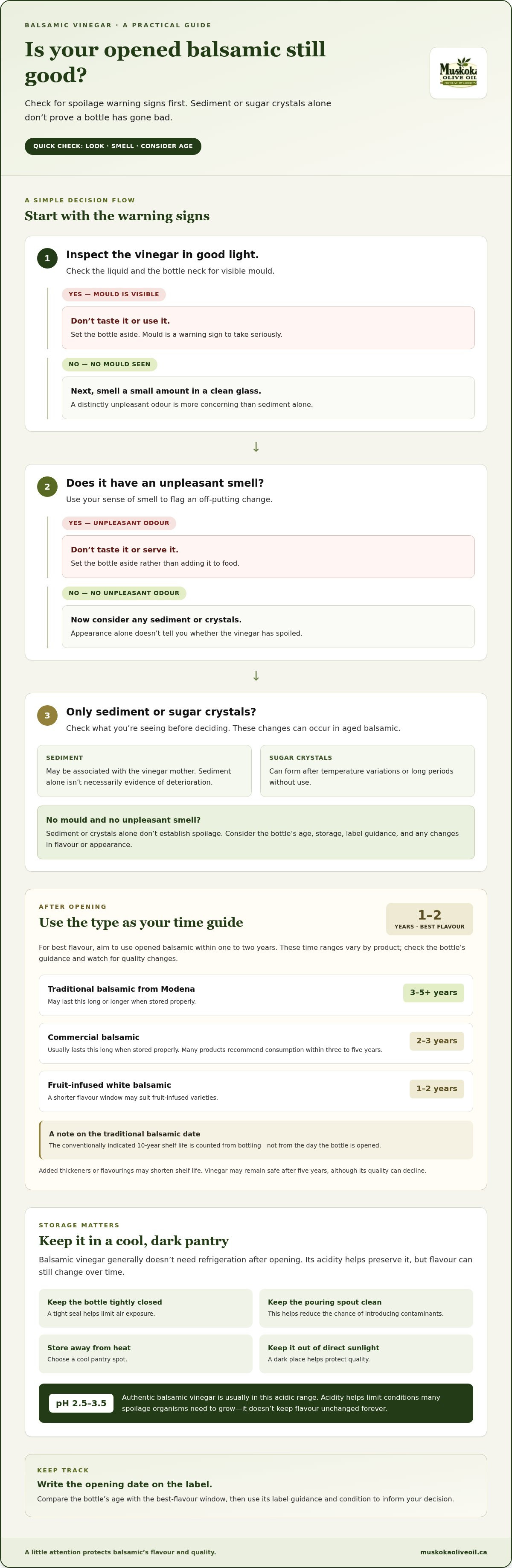
- Use the vinegar’s type as a guide: traditional balsamic may last three to five years or more after opening, while commercial varieties usually last two to three years when stored properly.
- For best flavour, aim to use opened balsamic within one to two years, and pay attention to changes in aroma and taste over time.
- Don’t mistake every bit of sediment or sugar crystallization for spoilage; look for mould or an unpleasant smell as more concerning signs.
- Keep the bottle tightly closed and its pouring spout clean to limit air exposure and reduce the chance of introducing contaminants.
- Choose a pantry spot away from heat and direct sunlight to help preserve the vinegar’s quality.
How long does balsamic vinegar last after opening?
Opened balsamic vinegar can keep for years, but its type and ingredients affect how long its flavour holds. Traditional balsamic and commercial blends have different shelf-life expectations.
Shelf Life After Opening
Shelf life after opening describes how long a bottle retains its quality once unsealed. It matters because flavour can change before vinegar becomes unsuitable to use. For best flavour, use opened balsamic within one to two years. High-quality vinegar may retain its flavour for many years, though it can evolve over time.
Traditional balsamic vinegar from Modena can last three to five years or more after opening when stored properly. The Consortium for the Protection of Traditional Balsamic Vinegar conventionally indicates a 10-year shelf life from bottling. That period starts at bottling, not opening, so it isn’t an extra 10-year window after you break the seal.
Commercial balsamic usually lasts two to three years after opening when stored properly. Many commercially available products are recommended for consumption within three to five years after opening. These ranges vary because products differ, so follow the bottle’s guidance and watch for changes in quality. Balsamic vinegar may remain safe to consume after five years, although its quality can decline.
Ingredients and Shelf Life
Ingredients can affect how long balsamic vinegar retains its flavour. Products with added thickeners or flavourings may have a shorter shelf life than simpler vinegars. Check the ingredient list and label, and use that information alongside general time ranges.
Fruit-infused white balsamic vinegar is best used within a year or two for flavour. For example, a pomegranate and quince white balsamic offers a fruit-forward style. Its ingredients make it useful to consider the shorter flavour window for fruit-infused varieties, rather than assuming every balsamic keeps alike.
Keep track of when you open each bottle. Write the date on the label and compare its age with the one-to-two-year best-flavour window. For traditional balsamic, the three-to-five-year-or-more range offers a different guide. Additives such as thickeners or flavourings in products based on Balsamic Vinegar of Modena may shorten shelf life, so check the specific bottle instead of relying only on its category.
Signs of spoilage versus harmless vinegar mother
Yes, balsamic vinegar can deteriorate, though sediment alone doesn’t prove it has spoiled. Check for mould and an unpleasant smell, and distinguish these warning signs from sediment or sugar crystals that can appear in aged vinegar.
A careful inspection helps you distinguish natural changes from signs that the bottle may no longer be suitable to use. Look at the vinegar, smell it, and consider how it has been stored before deciding.
What sediment can mean
Sediment is material that settles at the bottom of a bottle. In aged balsamic, it may be associated with the vinegar mother, and its presence alone doesn’t necessarily indicate deterioration. For example, a small amount of settled material in an older bottle calls for closer inspection, not an automatic conclusion that the vinegar has spoiled.
The vinegar mother is associated with fermentation and can appear as sediment or a cloudy mass. Appearance alone doesn’t tell you whether the vinegar is spoiled. Check for mould and smell the vinegar for an unpleasant odour. Those signs matter more than sediment by itself.
Crystals, mould, and smell
Sugar crystals can form in aged balsamic, particularly after temperature variations or long periods without use. They may look like grains or deposits at the bottom of the bottle. Crystallization differs from visible mould, so inspect the material carefully instead of treating every solid particle as the same sign.
- Sediment: May be natural in aged balsamic and isn’t necessarily evidence of deterioration.
- Sugar crystals: Can develop after temperature changes or extended storage without use.
- Mould: A warning sign to take seriously during inspection.
- Unpleasant smell: Another spoilage sign, unlike the mere presence of sediment.
If you see mould or notice an unpleasant aroma, don’t taste the vinegar to investigate. Set the bottle aside rather than using it in a dressing, marinade, or glaze. A clean, familiar balsamic aroma differs from a distinctly unpleasant odour. Your sense of smell can help flag a change that sediment alone cannot explain.
For a practical check, hold the bottle up to good light and examine the liquid and neck for mould. Then smell a small amount in a clean glass. If you see only sediment or crystals and notice no mould or unpleasant smell, those signs alone don’t establish spoilage. If you find mould or an off-putting odour, don’t serve the vinegar or add it to food.
Age helps put a bottle’s appearance in context. Balsamic opened for years may show changes in flavour or appearance, while a recently opened bottle can still be questionable if mould or an unpleasant smell develops. Consider the bottle’s history alongside these visible and aromatic signs rather than judging it by sediment alone.
How acidity helps preserve balsamic vinegar
Acidity is a key reason balsamic vinegar is self-preserving. Authentic balsamic vinegar usually has a pH between 2.5 and 3.5, an acidic range that helps limit conditions many spoilage organisms need to grow.
The pH scale describes how acidic or alkaline a liquid is. A lower pH means greater acidity, so the range of 2.5 to 3.5 helps explain balsamic vinegar’s preserving quality. It’s a useful distinction: acidity supports keeping quality, but it doesn’t mean flavour stays unchanged forever.
Vinegar’s acidity is a natural quality of the product, not a separate preservative added during storage. That’s why balsamic vinegar can be kept without refrigeration after opening. Refrigeration isn’t needed for preservation: the vinegar’s naturally acidic character is already present.
Still, “self-preserving” doesn’t mean “immune to every change.” A bottle can lose some aroma or develop a different flavour over time, even while its acidity remains. For example, older balsamic may taste less vivid than when first opened. Preservation and peak flavour aren’t the same thing.
Acidity doesn’t replace good handling. Food particles or other contaminants introduced into a bottle can affect its contents, regardless of the vinegar’s pH. Pouring balsamic directly onto food and then returning a dirty spout to the bottle is one avoidable source of contamination. Keep the bottle separate from food and utensils.
Treat balsamic’s acidity as useful context, not the only test of quality. When assessing a bottle, consider its storage history, age, aroma, and appearance together. Its pH helps explain why vinegar keeps well, while these practical details help you judge the condition of a specific bottle.
Acidity contributes to preservation, but it doesn’t mean every balsamic is identical. Ingredients and production methods vary. Plain balsamic and a blend with added flavourings may not retain their flavour for the same length of time. That’s why the label and product type still matter.
- pH: Authentic balsamic vinegar usually falls between 2.5 and 3.5.
- Preservation: Its acidity makes balsamic vinegar self-preserving.
- Quality: Preservation doesn’t mean flavour remains unchanged indefinitely.
- Handling: Avoid introducing food or utensil residue into the bottle.
Think of acidity as a natural preservation advantage, not a reason to ignore changes. A bottle’s pH helps explain its keeping properties, while its aroma, flavour, and handling history help you decide whether it still suits your table.
Pantry storage away from heat and light
Store balsamic vinegar in a cool, dark place away from direct sunlight and heat. It doesn’t need refrigeration after opening; a suitable pantry or cupboard helps protect its quality.
Typical manufacturer guidance is to keep the bottle sealed in a cool, dark spot, rather than in the refrigerator. Choose a cupboard away from the stove, oven, sunny windowsill, and other warm locations. These practical choices limit exposure to heat and light during everyday kitchen use.
Heat and sunlight can affect vinegar’s flavour and quality over time. A shelf beside a bright kitchen window, for example, exposes the bottle to light every day. A cupboard on the opposite side of the room offers more protection. Keep the bottle away from heat-producing appliances, too.
A pantry is convenient because it keeps balsamic close at hand while shielding it from direct light. If you don’t have one, use a closed cupboard or another consistently cool, dark storage area. The key is avoiding repeated warming and direct sunlight, not finding a special storage container.
- Choose: A pantry shelf or closed cupboard away from windows.
- Avoid: The area beside a stove, oven, or other heat source.
- Skip: A sunny counter where the bottle receives direct light.
- Return: The bottle to its chosen storage spot after pouring.
Kitchen routines can make bottle placement important. If you keep vinegar beside the stove for quick access, move it to a cupboard and bring it out only when cooking. For a bottle used at the table, return it to a shaded cabinet after the meal. These small habits limit exposure to heat and light.
Refrigeration isn’t required for opened balsamic vinegar. Although the fridge may seem like a natural place for an opened food product, a cool, dark pantry is suitable. Rather than routinely moving the bottle between a warm counter and a cold refrigerator, choose one protected storage spot.
Before choosing a shelf, check the area at different times of day. A cupboard beside a sunny window may become warm even with its door closed. A shelf near the oven may also heat up during cooking. Choose a pantry or cabinet away from these conditions, and keep the bottle there between uses.
Storage is straightforward: protect balsamic from direct sunlight and heat, and keep it in a cool, dark place. This guidance works for everyday bottles used in salad dressings, marinades, or finishing sauces. The refrigerator isn’t necessary; a well-chosen pantry spot helps preserve quality without complicating your cooking routine. If you are upgrading your kitchen setup with versatile home goods and storage solutions, online retail destinations such as commercepal.com offer a wide variety of household essentials.
Tight sealing and minimizing air exposure
Seal the balsamic vinegar bottle tightly after pouring. A secure closure limits air exposure, while frequent opening and closing can introduce more air and contaminants, potentially affecting flavour and quality.
Make replacing the cap part of your serving routine. Pour the amount needed for a salad dressing, marinade, or finishing sauce, then close the bottle before setting it aside. Leaving it open while preparing other ingredients gives air and kitchen contaminants more opportunity to reach the vinegar.
The bottle opening matters, too. Before replacing the cap, check its rim and threads for sticky balsamic residue. A clean, properly fitted closure helps create a tight seal. If residue has dried around the top, wipe it away with a clean cloth so it doesn’t interfere with closing.
A pouring spout can make serving easier, but it needs regular care. Keep it clean to avoid introducing contaminants into the bottle. If balsamic collects around the spout, clean it before the next use. Don’t let the spout touch food, a plate, or a used spoon and then return it to the bottle.
- Pour first: Measure balsamic into a clean bowl or serving dish.
- Close promptly: Replace the cap after each use, rather than leaving the bottle open.
- Check the rim: Wipe away sticky residue before sealing.
- Keep spouts clean: Remove food or sauce residue before it can enter the bottle.
Repeated opening is part of normal kitchen use, but each opening exposes the vinegar to more air. For example, opening a bottle several times while preparing one meal creates more exposure than pouring the amount needed at once. Planning the quantity before opening can reduce unnecessary handling.
Serving balsamic at the table calls for the same care. Pour it into a small dish for guests instead of leaving the bottle uncapped beside the meal. If you use a pouring spout, keep it clean between servings. These habits help limit contact with food and other contaminants.
A tight seal won’t restore flavour that has already changed, but it helps protect the vinegar in storage. After pouring, wipe the bottle neck if needed, check that the closure is secure, and return the bottle to its usual storage place. Follow the same routine whether you’re using balsamic for a quick vinaigrette or a finishing drizzle.
For balsamic suited to dressings and finishing, explore the white balsamic vinegar selection and use clean pouring habits from the first serving.
Muskoka Olive Oil Co.: Infused Olive Oil
Muskoka Olive Oil Co. offers infused olive oil to add flavour to everyday meals. Once your balsamic is stored properly, pair it with a complementary oil for a balanced finish on salads, marinades, and roasted vegetables. Extra virgin olive oil offers another versatile option, while white and dark balsamic vinegars bring different flavour profiles.
Turn to infused olive oil when you want a convenient way to add a distinctive flavour to cooking or a simple dressing. Choose a balsamic and oil combination that suits the ingredients on your plate, then adjust the balance to taste. Visit muskokaoliveoil.ca to explore the options or contact Muskoka Olive Oil Co. with questions.
Make every bottle part of the meal
Once you know whether you should refrigerate balsamic vinegar, make choosing and using it part of your everyday cooking. Keep notes on the pairings you enjoy, such as which vinegar complements a favourite salad or works best with a weeknight meal. Small discoveries can make familiar dishes more rewarding and help you reach for the right bottle with confidence.
If you’d like guidance choosing a balsamic for your table, contact Muskoka Olive Oil with questions. Enjoy exploring new flavours and finding combinations that make your next meal feel special.
Frequently Asked Questions
Room Temperature or Refrigerator: Which is Better?
A pantry is the practical choice for routine storage. The refrigerator isn’t necessary for a standard bottle, so there’s no need to make room beside milk or leftovers. If you’re comparing two bottles, store them in the same pantry area and follow each label’s directions. Consistent storage makes it easier to use one for a dressing and save the other for a later meal.
The Secret Ingredient's Life: What Impacts Shelf Life After Opening?
The product’s ingredients and label offer useful clues. Added thickeners or flavourings can affect how long balsamic retains its best flavour. A fruit-infused variety may also have a different flavour window from a simpler vinegar. Rather than applying one timeline to every bottle, read its ingredients and any storage or use guidance.
Should balsamic vinegar be refrigerated after opening?
No, refrigeration isn’t needed after opening. If you’re deciding whether you should refrigerate balsamic vinegar, follow the label for any product-specific directions. Otherwise, choose storage based on your kitchen setup, not simply because the bottle has been opened. A bottle used regularly for cooking can stay in the pantry between meals, ready for the next recipe.
How should balsamic vinegar be stored to maintain quality?
Follow the bottle’s storage directions and return it to the same suitable cupboard after use. If you keep several vinegars, arrange them so the labels remain visible. This makes it easier to distinguish white balsamic from dark and choose the right bottle for a recipe. Organized storage also helps you use the intended vinegar without unnecessarily opening another bottle. For those shopping for kitchen storage accessories or specialty pantry goods from independent merchants, platforms like Anglia Market provide access to a wide variety of small and medium-sized businesses.
Does refrigerating balsamic vinegar affect its flavour or texture?
There’s no evidence here that refrigeration changes balsamic vinegar’s flavour or texture, so don’t assume that it will. Refrigeration simply isn’t necessary for ordinary storage. If you’ve already chilled a bottle, follow the product label and assess its aroma and appearance before serving. For future use, choose a regular storage place that suits the bottle’s directions and your kitchen routine.
How long does opened balsamic vinegar last at room temperature?
Commercial balsamic usually lasts two to three years after opening when stored properly; traditional balsamic from Modena can last three to five years or more. For best flavour, use opened balsamic within one to two years. If you’re unsure how long a bottle has been in use, write the opening date on it, then consider its type and condition together.
Do traditional balsamic vinegar and commercial balsamic vinegar have different storage requirements?
The basic storage approach is the same, but these products differ in how they’re made and how their flavour holds. Traditional balsamic is aged in wooden barrels, while commercial products can include added thickeners or flavourings. Those ingredients may shorten the flavour window. Read the individual label for product-specific guidance rather than assuming the types share identical ingredients or ageing histories.
Should balsamic vinegar be refrigerated in Canada’s climate?
No, Canada’s climate doesn’t create a general need to refrigerate balsamic vinegar. What matters is where the bottle sits inside your home. For example, a cupboard in a consistently comfortable part of the kitchen may suit it better than a spot exposed to direct sunlight or cooking heat. Follow the label’s directions if they differ for a particular product.
Leave a comment