


Early Harvest Olive Oil: When Olives Are Picked and Why It Matters
Earlier picking trades quantity for character. To understand what early harvest olive oil is, start with the olives: they’re picked before they fully ripen, often around early October. They can yield 30-50% less oil than fully ripe olives, while making oil that’s greener, grassier and often more bitter and peppery.
It’s easy to assume riper fruit always makes better oil, but harvest timing shapes flavour as well as yield. Early-harvest olive oil can bring a vivid, herbaceous quality to the table, with pleasant bitterness and a peppery finish that may surprise first-time tasters.
Learn when early-harvest olives are picked, how ripeness affects the oil’s flavour and yield, and what its polyphenols may mean for health. We’ll also look at how early-harvest oil is made and where its lively character works well in everyday cooking, so you can make sense of what to look for when choosing extra virgin olive oil.
Key Takeaways
- Look for harvest timing on the label to understand when the olives were picked and how early in the season the oil may be.
- Expect greener, firmer olives to produce a livelier oil, often with grassy aromas and a more noticeable bitter or peppery finish.
- Early picking means less oil per olive, which helps explain why these oils can be more limited in yield.
- Polyphenol levels vary between oils; treat them as one quality detail, not a promise of a specific health outcome.
- Use the oil’s bold flavour to finish salads, vegetables or other dishes where its fresh, peppery character can stand out.
What is Early Harvest Extra Virgin Olive Oil?
Early-harvest extra virgin olive oil comes from olives picked before they fully ripen, often while they’re still green and firm. Picking them earlier produces a brighter, more herbaceous flavour and usually less oil per olive.
To see how harvest timing influences the finished oil, watch this overview:
Store the bottle in a cool, dark area, as recommended by Kendall Reagan Nutrition Center, and close it after pouring. Use this harvest EVOO as a finishing oil on salads, vegetables or pizza, where its flavour stays prominent.
Quality extra virgin olive oil has a smoke point of 190-210°C. That figure doesn’t make high-heat cooking the best use for every bottle: early harvest oil’s lively aromas and flavour are especially suited to finishing dishes.
Flavour and polyphenol content
Early-harvest oils often taste grassy and fruity, with distinct bitterness and a peppery finish. They can also contain more polyphenols than oils from riper olives. Polyphenols are naturally occurring compounds in olives, and their levels vary with the fruit and production.
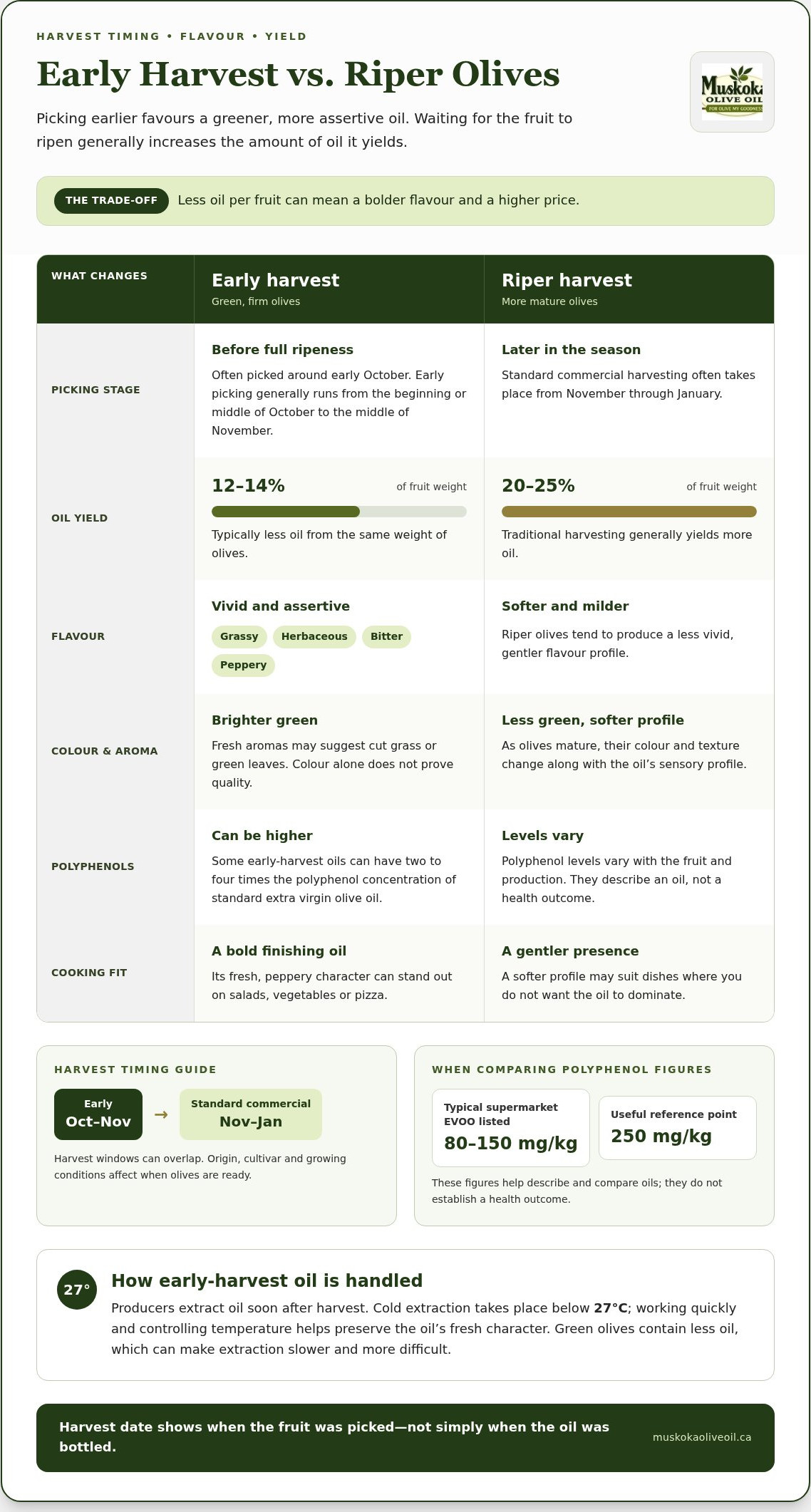
Some early harvest oils can have two to four times the polyphenol concentration of standard extra virgin olive oil. For comparison, typical supermarket EVOO is listed at 80-150 mg/kg, while 250 mg/kg is a useful reference point when comparing figures. These values help describe an oil, but don’t establish a health outcome.
Colour and aroma characteristics
Early-harvest oil often has a brighter green colour and fresh, herbaceous aromas that may suggest cut grass or green leaves. Natural olive pigments contribute to its colour, while aroma offers another clue to the oil’s character.
When tasting, smell the oil first, then try a small amount and notice its bitterness and pungency. A green appearance alone doesn’t prove quality, so consider colour alongside aroma and flavour. Compared with oil from riper olives, the profile is often more vivid and less soft.
Price and flavour trade-offs
Early harvesting means less oil from the same weight of fruit, which can contribute to a higher price. Early-season olives typically yield around 12-14% of their weight as oil, compared with around 20-25% for traditional harvesting.
The trade-off involves flavour as well as quantity: early harvest may bring more bitterness, pungency and fresh green notes, while riper olives tend to yield more oil with a softer flavour. Choose based on how you’ll use it. A bold finish can stand out on a salad, while a gentler profile may suit dishes where oil shouldn’t dominate.
Production methods
Producers extract oil from early-picked olives soon after harvest, with cold extraction described as taking place below 27°C. Working quickly helps limit deterioration before milling, while controlled temperatures help preserve the oil’s fresh character.
Green olives contain less oil, which can make extraction slower and more difficult. Their lower yield, along with the greater effort involved in harvesting firmer fruit, helps explain why early-harvest EVOO is valued for its distinctive profile. Its grassy aroma, bitterness and peppery finish can give everyday dishes a lively finishing touch.
Definition and timing of early harvest olive oil
Early-harvest extra virgin olive oil is made from olives picked before they fully ripen. In many olive-growing regions, early picking begins around early October, within a broader harvest season that typically runs from October to December.
Early and regular harvest timing
Early harvest means picking olives near the start of the season, while regular commercial harvesting often takes place later. Early olive harvesting generally occurs between the beginning or middle of October and the middle of November. The standard commercial harvest runs from November through January.
These windows overlap because harvest dates vary by origin, cultivar and growing conditions. For someone choosing an extra virgin olive oil, a harvest date provides useful context: it shows when the fruit was picked, not simply when the oil was bottled. A label showing “Harvest 2025/26,” for example, identifies the harvest year. The date helps compare oils from different places and seasons.
Harvest timing and olive ripeness
Harvest timing is closely linked to how far olives have ripened on the tree. Early-picked olives are generally green and firm; as they mature, their colour and texture change, and they yield more oil. This shift affects both the amount produced and the oil’s sensory profile.
Picking earlier favours a fresh, robust character, while later picking tends to produce more oil from the fruit. Neither timing alone defines quality. Extra virgin status depends on the finished oil meeting the relevant quality criteria; harvest timing describes the fruit’s maturity when picked. Considering both gives you a fuller picture than relying on the phrase “early harvest EVOO” alone.
Seasonal conditions and harvest timing
The calendar offers a useful guide, but the fruit’s development on the tree matters too. Weather and growing conditions influence how quickly olives mature, so producers consider ripeness and local conditions when deciding when to harvest. A single fixed date can’t describe every grove or origin.
Harvest timing also differs across countries. In Greece, early-harvest olives are typically picked in October-November, and the Koroneiki variety is widely used for Greek olive oil production and suits early harvesting. This shows why origin and harvest date together can be more informative than calendar dates alone. Oils from different regions may reach their preferred picking stage at different points in the season.
For cooking, the harvest date can help you anticipate whether an oil may taste greener and more assertive or softer and milder. Compare the date with the stated origin and variety, then consider how you’ll use the oil. Harvest information offers a practical starting point for understanding the fruit behind the bottle.
Polyphenols and potential health benefits
Polyphenols are naturally occurring compounds in olives that contribute to an oil’s bitterness and peppery character. Their concentration can vary with olive variety, maturity and growing conditions, so the harvest date is one useful clue, not a complete measure of quality.
Polyphenol concentration and maturation
As olives mature, their polyphenol levels can change, and later harvesting may produce oil with fewer of these compounds. For example, early-harvest Picual olives from Jaén can produce oil with more than 500 mg/kg of total polyphenols.
Picual olives harvested two months later may produce oil with 150-200 mg/kg. This comparison shows why maturity matters when comparing oils, but figures also depend on the cultivar and growing conditions. The peppery sensation in a tasting can offer a sensory clue, though it cannot replace a measured polyphenol result.
Harvest dates and polyphenol levels
A harvest date helps put an oil’s measured polyphenols in the context of the season when its olives were picked. Compare the date with the stated origin and olive variety. A Spanish Picual and a Greek Koroneiki, for example, may differ in growing conditions and composition.
Harvest timing is only one influence. Processing and storage also affect the compounds that remain in the bottle. A laboratory figure allows a more direct comparison than the phrase “high polyphenol,” which has no consistent value on its own. When both are provided, read the harvest information alongside the reported measurement.
Antioxidants and polyphenols
Polyphenols are among olive oil’s antioxidant compounds. Antioxidants help limit oxidation, a process that gradually affects oil quality. These same compounds also contribute to bitterness and pungency.
These properties can help explain flavour and freshness, but they don’t establish health benefits for an individual. Research on extra virgin olive oil belongs in the context of an overall eating pattern, not as a promise that one oil prevents or treats disease. A peppery finish can signal a distinctive taste, but it isn’t a clinical test of antioxidant content.
Polyphenols aren’t the only quality measure. Free acidity and peroxide value assess different aspects of oil quality: free acidity reflects fatty acids released from the oil’s triglycerides, while peroxide value indicates primary oxidation. Extra virgin olive oil must have free acidity no higher than 0.8%; that measure alone doesn’t reveal polyphenol concentration or guarantee a particular flavour.
For a practical comparison, note the harvest date, origin, variety and any stated polyphenol figure. Then taste the oil, if possible, and consider whether its bitterness suits your cooking. These details help distinguish measurable composition from flavour language, while keeping potential health benefits in perspective.
Definition and ripeness of early-harvest olives
Olive ripening is gradual, not a switch that changes every fruit at once. Within a single grove, fruit can develop at different rates, so the harvest decision balances conditions across trees and sections rather than targeting one perfectly uniform stage.
That variation matters when interpreting an oil’s character. A batch may include olives at slightly different stages of maturity, even when picked during the same harvest. The final oil reflects the blend of fruit brought to the mill, as well as the cultivar and growing conditions.
Ripeness also explains why the calendar alone can’t define an early harvest. The same date can correspond to different stages in separate growing regions or seasons. Producers base their decision on the condition of the fruit, not merely the month on a schedule.
For shoppers, “early” is relative to the local growing cycle. An October harvest in one origin may not represent the same stage of fruit development as an October harvest elsewhere. Compare origin and harvest information together, rather than treating a calendar date as a universal measure of ripeness.
Olive variety adds another layer. Cultivars don’t all develop at the same pace or respond identically to growing conditions. As a result, two oils harvested at a similar stage can still have different overall characters. Maturity is part of the explanation, not a complete prediction of what’s in the bottle.
Decisions about ripeness also involve a practical balance for growers: picking earlier or waiting changes the fruit available for milling. There’s no single maturity point that applies to every grove, because the desired result and local conditions shape the choice.
When evaluating an oil, treat ripeness as context for understanding its origin and production, not as a stand-alone quality grade. A clear harvest year tells you when the olives were picked, while the cultivar and region help explain why oils from different groves may taste different.
How is early harvest olive oil made?
Early-harvest oil starts with careful picking and prompt milling. Because green olives contain less oil, both stages can take more effort.
Harvesters pick firm, early-season fruit while taking care to avoid bruising it. The work can be more labour-intensive because firmer olives are harder to remove from the tree. Harvesting during the coolest hours of the day can also help avoid damage when temperatures are relatively high.
Once picked, olives are transported to a mill and processed promptly. Early-harvest extra virgin olive oil can be cold-extracted within 12 hours of harvest. This short interval limits the time fruit spends waiting, when bruising or warmth could affect its condition before milling.
At the mill, the olives are cleaned to remove leaves and debris, then crushed into a paste. The paste is mixed so small oil droplets can join, then separated into oil, water and solid material. Modern mills use centrifuges for extraction, rather than relying on traditional stone presses. Cold extraction describes processing below 27°C; it refers to temperature, not a promise of a particular flavour or polyphenol level.
Green olives are more challenging to process because they contain less oil than riper fruit. Producing one litre of early-harvest extra virgin olive oil can take up to 11 kilos of olives. The exact amount depends on the cultivar, maturity and fruit condition. Koroneiki, for example, is a small olive with a high skin-to-flesh ratio, so its characteristics differ from larger varieties during milling.
After separation, the oil is stored away from light, heat and excess air before bottling. These conditions help protect freshness and preserve its sensory character. Dark glass can reduce light exposure in the kitchen, while a tightly closed cap limits contact with air between uses.
“Cold pressed” remains a familiar phrase, but modern olive oil is generally extracted once using mill equipment. The term can describe traditional practice; the temperature and timing of extraction offer more practical details about production. For shoppers, a harvest date, stated origin and fresh, balanced taste provide useful context alongside the production method.
To compare oils and explore their origins, browse extra virgin olive oils and consider how each suits your cooking.
Muskoka Olive Oil Co.: Infused Olive Oil
Muskoka Olive Oil Co. offers infused olive oils for cooks who want to add distinctive flavour to everyday dishes. Early-harvest extra virgin olive oil is defined by when its olives are picked; infused olive oil offers another way to shape a dish's flavour. Choose according to the taste you want in the finished meal.
An infused oil can add a flavourful accent to vegetables, marinades or a finishing drizzle. Explore the infused olive oil selection to find options for your cooking.
Explore Muskoka Olive Oil Co.’s olive oils online to find flavours for your kitchen.
Make your next tasting a discovery
Understanding early-harvest olive oil gives you a useful starting point, but tasting makes its character personal. Notice which flavours you enjoy and how they might complement a meal you already love. A peppery oil can add contrast to a simple plate, while a milder choice may suit a delicate dish.
Explore extra virgin olive oils, infused olive oils and white balsamic vinegars to discover different flavour combinations. Polyphenol figures can add context when comparing oils, but they don’t predict an individual health outcome.
Explore the selection and get in touch with the olive oil team for inspiration for your next meal. A thoughtful drizzle can make everyday cooking feel more your own.
Frequently Asked Questions
What is early harvest olive oil?
It’s extra virgin olive oil made from olives picked early in their ripening cycle. Treat “early harvest” as a clue about production, not a guarantee of a particular taste or quality. For a practical kitchen test, try a small amount on its own, then with a familiar dish. This helps you decide whether the oil complements your cooking before making it an everyday choice.
When are olives harvested for early harvest olive oil?
They’re picked near the beginning of the local olive harvest, often around October, though timing varies by origin and growing conditions. Calendar dates aren’t directly comparable across countries. If two bottles come from different regions, use the stated origin to put each harvest date in context. This is more useful than assuming the same month means olives reached the same stage everywhere.
How does early harvest olive oil taste compared with regular olive oil?
It usually has a more pronounced green, herbal character and a stronger bitter or peppery finish. Let the dish guide how you use it: a bold oil can stand up to beans, grilled vegetables or a robust salad dressing. For delicate fish or mild vegetables, start with a light drizzle so the oil enhances rather than overwhelms the other flavours.
Is early harvest olive oil more nutritious or higher in polyphenols?
It can have higher polyphenol levels than oil made from riper olives, but levels vary between oils. A reported figure describes composition; it doesn’t establish a personal health effect. When choosing oil for everyday meals, consider its taste and how it fits into your overall eating pattern. Olive oil is one ingredient, not a substitute for balanced meals or medical care.
Does early harvest olive oil have lower yield or cost more?
It generally produces less oil from the fruit, which can contribute to a higher price. Shelf price also reflects factors such as origin, production and packaging, so “early harvest” alone can’t predict what a bottle will cost. Compare the label details and choose an oil you’ll enjoy using. A bold oil can be especially satisfying as a finishing drizzle or in a dressing.
How can you identify genuine early harvest olive oil on a label?
Look beyond the phrase itself. A harvest year, named origin and producer details offer useful context, while a polyphenol figure can provide a measurable point of comparison when stated. “Early harvest” has no official definition, so it doesn’t certify an exact picking date. Check that the label details are clear and consistent, then use taste to decide whether the oil suits you.
Leave a comment