


Olive Oil Baking Conversion: How Much to Use in Recipes
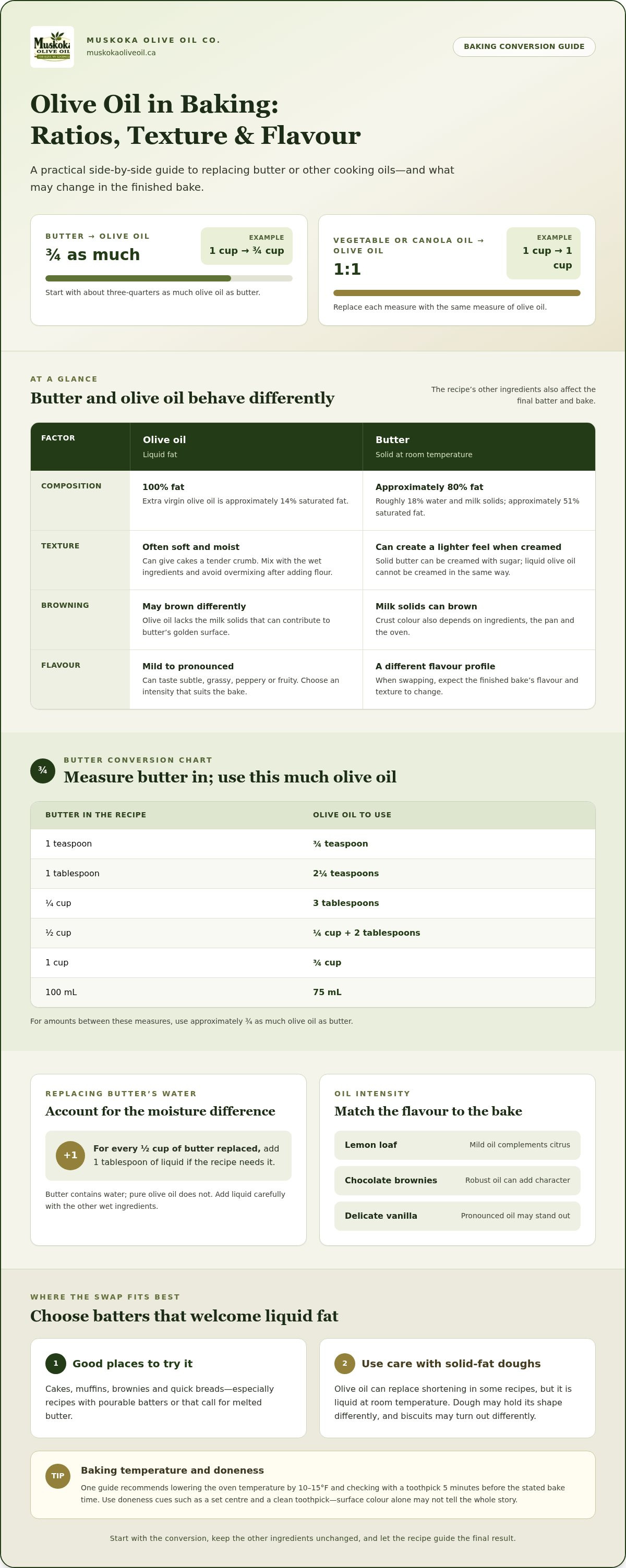
For vegetable or canola oil, use olive oil in a 1:1 ratio: replace each measure with the same measure of olive oil. For butter, start with about three-quarters as much olive oil; for example, use ¾ cup of olive oil in place of 1 cup of butter. This olive oil baking conversion gives you a practical starting point, while the recipe and the oil’s flavour help shape the final result.
It’s natural to wonder whether switching fats will make a cake heavy, change its browning or give it an overly strong olive-oil taste. Olive oil works well in many bakes, especially recipes that use melted fat. The key is understanding how it differs from butter and choosing an oil whose flavour suits the recipe.
Here, you’ll learn how to swap olive oil for vegetable oil or butter, what to expect from the texture and flavour, and how to adapt a boxed cake mix. We’ll also look at which baked goods tend to suit olive oil and why the right choice can bring a tender crumb and a gentle, savoury-fruity note to your kitchen.
Key Takeaways
- Use the same amount of olive oil in place of vegetable or canola oil, and start with about three-quarters as much when replacing butter.
- Olive oil can bring a tender, moist texture and a distinct flavour; choose an oil that complements the other ingredients.
- Cakes, muffins, brownies and quick breads are promising places to try olive oil, especially when a recipe calls for melted butter.
- In boxed cake mix, olive oil can take the place of the vegetable oil while keeping the recipe’s measured amount unchanged.
- Explore infused olive oils from Muskoka Olive Oil Co. when you want to add a new flavour note to your baking.
Why Replace Butter with Olive Oil?
Olive oil can replace butter in many baking recipes, but the amounts usually aren’t equal. Start with about three-quarters as much oil as butter, then account for the moisture butter contributes.
Butter is approximately 80% fat and contains roughly 18% water and milk solids; olive oil is 100% fat. Their fat profiles differ too: butter is approximately 51% saturated fat, while extra virgin olive oil is approximately 14% saturated fat. These differences affect both the ingredient balance and the character of a bake.
An olive oil baking conversion chart makes the volume adjustment easy to scan:
- 1 teaspoon butter: use ¾ teaspoon olive oil.
- 1 tablespoon butter: use 2¼ teaspoons olive oil.
- ¼ cup butter: use 3 tablespoons olive oil.
- ½ cup butter: use ¼ cup plus 2 tablespoons olive oil.
- 1 cup butter: use ¾ cup olive oil.
For amounts between these measures, use the same general ratio: approximately ¾ as much olive oil as butter. This olive oil baking conversion is a starting point; the recipe’s other ingredients also affect the batter.
Replacing Butter’s Water Content
Butter contains water, while pure olive oil does not. Replacing butter with oil can therefore change the batter’s moisture balance. If the recipe needs additional liquid to reach a workable consistency, add it carefully and keep in mind that the result depends on the recipe.
Add 1 tablespoon of liquid for every ½ cup of butter replaced. For example, when replacing ½ cup butter in a cake, add that liquid with the other wet ingredients.
Choosing Olive Oil for Baking
Extra virgin olive oil brings its own flavour, while lighter-tasting olive oils are generally milder. Choose based on whether you want the oil’s character to stand out or stay subtle.
In a lemon loaf, a mild oil can complement the citrus. A more robust oil may pair well with chocolate, whose flavour can balance stronger notes.
Substituting Olive Oil for Shortening
Olive oil can replace shortening in some recipes, but it is liquid while shortening is solid at room temperature. That difference can change how a dough holds its shape.
Oil is more practical in moist batters, such as quick breads, than in recipes that rely on solid fat for flaky layers. A biscuit may turn out differently after this swap.
Smoke Point and Other Baking Risks
Smoke point is the temperature at which an oil begins to smoke, and it varies by oil. When baking with olive oil, its flavour and the effect on texture also matter.
One guide recommends lowering the oven temperature by 10-15°F and testing doneness with a toothpick 5 minutes before the recipe’s stated bake time. A pronounced oil can overwhelm a delicate cake, so match its flavour to the other ingredients.
Canadian recipes may list ingredients in cups, tablespoons or millilitres. Keep units consistent: for example, 100 mL butter converts to 75 mL olive oil using the three-quarter ratio.
Changes to texture, browning, and flavour
Swapping butter for olive oil changes how a batter feels, colours and tastes. In a vanilla loaf, for example, the crumb may feel more tender, the crust may brown differently, and the oil’s flavour can linger after each bite.
Texture: Olive oil is liquid at room temperature, unlike solid butter. This affects mixing and the finished crumb. A cake made with oil often has a soft, moist texture, while butter can help create a lighter feel when creamed with sugar. Because olive oil can’t be creamed in the same way, follow the recipe’s method and mix it with the wet ingredients. Avoid overmixing after adding flour, which can make a loaf or muffin tougher.
Browning: Butter can contribute milk solids that brown during baking. Olive oil lacks those solids, so a cake or muffin may not develop the same golden surface. Colour also depends on ingredients such as sugar, eggs and cocoa, as well as the pan and oven. A light-coloured cake may look less golden even when its centre is fully baked. Use the recipe’s doneness cues, such as a set centre and a clean toothpick, rather than relying on crust colour alone.
Flavour: Olive oil’s flavour can range from mild and subtle to grassy, peppery or fruity. In lemon cake, a fruity oil can complement citrus; in delicate vanilla cupcakes, a pronounced oil may stand out. Chocolate, spices and ripe bananas can balance more robust notes. The result depends on the oil and other ingredients, so treat the oil as part of the recipe’s flavour, not just a neutral background fat.
For a balanced first test, match the oil’s intensity to the baked good. A mild oil suits a simple sponge, while a robust extra virgin olive oil can add character to chocolate brownies. Keep the other ingredients unchanged for that first bake. This makes it easier to judge the oil’s effect on flavour, texture and browning before adjusting the recipe.
For comparison, bake the same muffin recipe in two batches, using olive oil in one and the original fat in the other. Note the batter’s thickness, the colour of the tops and the crumb after cooling. A warm muffin can seem softer than one that has fully cooled, so compare both batches at the same stage. These observations can help you decide whether to choose a milder oil or adjust the mixing method next time.
Bakes that work well with olive oil
Olive oil works especially well in cakes, muffins, brownies and quick breads. These baked goods usually have pourable batters, so liquid oil blends readily with the wet ingredients. Recipes that call for melted butter are also convenient candidates because they don’t depend on creaming solid butter with sugar.
Cakes: A simple loaf cake or snack cake can work well with olive oil and usually needs no special mixing method. Choose a flavour that welcomes the oil’s character, such as orange, lemon or chocolate. For delicate vanilla cake, use a mild extra virgin olive oil so its flavour doesn’t dominate. In a citrus cake, a fruity note can complement the zest.
Muffins and quick breads: Banana bread, zucchini bread and breakfast muffins have moist batters that incorporate oil easily. Add the oil with the other wet ingredients, then fold in the flour just until combined. A blueberry muffin recipe that calls for melted butter is a straightforward place to test the swap. Avoid vigorous mixing after adding flour, which can make the crumb tougher.
Brownies: Oil can suit brownies because their rich cocoa flavour works with the fruity or peppery notes of some olive oils. Follow the recipe’s mixing order, especially if it asks you to melt chocolate before adding the fat. A mild oil keeps the chocolate prominent; a more robust one gives the finished brownies a distinct savoury edge.
Olive oil is not suited to every bake. Recipes that rely on solid butter for structure, such as some flaky pastries or creamed cookies, may behave differently with liquid oil. The fat’s state affects how ingredients combine, so a direct swap can change spread and texture. For a first attempt, choose a cake or quick bread rather than a pastry that depends on distinct layers.
Use the recipe itself to judge how easy a substitution will be:
- Good starting point: a cake, muffin, brownie or quick bread with liquid ingredients.
- Especially convenient: a recipe that calls for melted butter.
- More sensitive to change: a cookie or pastry recipe that creams solid butter or needs flaky layers.
Keep the other ingredients and mixing steps unchanged during your first test. A slice of olive-oil cake or a batch of muffins will then give you a clearer sense of the oil’s effect. If the flavour is too pronounced, choose a milder oil next time. If the baked good suits the oil’s fruitiness, keep that pairing for the recipe.
Moisture retention and crumb density
Olive oil’s liquid form affects how a cake holds moisture and feels when sliced. Compared with butter-based versions, olive oil cakes can stay pleasantly moist for 3-5 days when stored properly. That quality can make a difference for a loaf baked ahead for breakfast or dessert.
The result depends on how the fat behaves in the batter. Olive oil coats flour and adds richness throughout the crumb, while butter is solid when cool and can create a different structure. The outcome also depends on the balance of flour, eggs, sugar and liquid. A dense chocolate loaf, for example, may feel naturally substantial, while a plain cake can show the oil’s effect more clearly.
Consider banana bread. A loaf made with extra virgin olive oil can remain soft and tender on day three. A butter-based version tends to dry out by day two. These are useful comparisons, but the recipe’s mixing method and storage still matter. A dry loaf may also be overbaked, so check for doneness rather than leaving every cake in the oven until its top looks deeply browned.
Crumb density isn’t simply a matter of adding more oil. A heavy or gummy centre can result from overmixing, an unbalanced batter or cutting the loaf before it cools. For an even slice, mix wet and dry ingredients only until combined, then let the baked loaf cool fully. In a Mediterranean-style olive oil cake, cooling also lets the crumb set before serving.
Storage affects how a bake tastes over several days. Keep a cooled cake covered so its exposed crumb doesn’t dry out. A cut banana loaf, for instance, loses moisture faster at the sliced end than an uncut loaf. Protect the cut face when storing the remainder, then compare a slice the next day with one served fresh.
To assess a recipe, note the crumb after cooling, the next day and later in the storage period. Record whether each slice feels tender, oily, dense or dry. If a lemon loaf stays pleasant but tastes too rich, consider a milder oil next time. If a chocolate cake feels heavy, review the mixing and baking before changing the amount of fat.
Olive oil can influence both keeping quality and crumb, but it isn’t the only factor. The ingredients, mixing and baking all matter. Let the texture you want guide your choice: a tender banana bread may suit olive oil, while a delicate cake calls for a lighter touch.
Olive oil in boxed cake mix
Olive oil can replace vegetable or canola oil in boxed cake mix at a 1:1 ratio. If the package calls for ⅓ cup vegetable oil, measure ⅓ cup olive oil instead. Keep the mix, eggs, water and other listed ingredients at their stated amounts. This direct swap makes a boxed mix a simple way to explore how olive oil affects a familiar cake.
Choose an oil whose flavour suits the mix. A mild extra virgin olive oil can work in vanilla or white cake, where a strong taste might distract from the delicate flavour. Chocolate cake has a more pronounced profile, so a fruity or peppery oil may be less noticeable alongside the cocoa. Olive oils vary in intensity, and the finished cake’s flavour depends on both the oil and the mix.
Use this quick guide to match the oil to the cake:
- Vanilla or white cake: choose a mild oil for a subtle result.
- Chocolate cake: consider an oil with a more noticeable flavour.
- Citrus cake: a fruity oil can complement lemon or orange notes.
Follow the package’s mixing sequence. If the directions say to combine the cake mix, eggs, water and oil in one bowl, add the olive oil with those ingredients. Mix only as directed, scraping the bowl as needed to incorporate dry pockets. The goal is an even batter, not extra mixing that could change the cake’s texture.
Keep the package’s pan size and baking directions unchanged for your first test. Check the cake using the provided doneness cues, since a darker or lighter surface alone doesn’t show whether the centre is ready. Let the cake cool as directed before slicing. This gives you a fair chance to assess its crumb and flavour instead of judging it while hot.
For an easy comparison, bake the same boxed mix twice: use the specified vegetable oil in one batch and olive oil in the other. Keep the pan, added ingredients and mixing method consistent. Taste both after cooling, noting whether the olive-oil cake tastes fruity, peppery or subtle. This side-by-side test can help you decide which olive oils suit your favourite boxed mixes.
Once you know the flavour you prefer, you can explore extra virgin olive oils for future baking experiments.
Muskoka Olive Oil: Infused Olive Oil
Muskoka Olive Oil Co. offers infused olive oil for bakers who want to add another flavour note to a familiar recipe. It can suit a cake, muffin or quick bread when the flavour complements the other ingredients. Before choosing one for your batter, consider how its flavour might pair with citrus, chocolate or warm spices.
When replacing vegetable oil in a boxed mix, use the same measured amount of infused olive oil. Keep the other ingredients and mixing directions unchanged, then taste the cooled cake to see how the flavour comes through. For a more classic result, extra virgin olive oil is another option; let the oil’s flavour guide your choice.
For help exploring olive oils for everyday cooking and baking, visit muskokaoliveoil.ca.
Let flavour guide your next bake
Think of an olive oil baking conversion as a choice about the kind of bake you want, not a rule for every recipe. Some days call for a familiar favourite; other times, a small change can make an everyday bake feel more personal. Let your preferences, rather than a strict idea of how a recipe “should” taste, guide what you try next.
Choose a recipe you already enjoy, make it for a relaxed occasion, and pay attention to what makes the result satisfying for you. That might be its aroma as it comes from the oven, the way it feels alongside a cup of tea, or whether you’d happily serve it again. Your own judgement is the most useful guide for deciding which adaptations belong in your kitchen.
If you’d like to discuss an olive oil for a baking idea, contact Muskoka Olive Oil Co. Enjoy the discovery, and make the next bake your own.
Frequently Asked Questions
How to Use Olive Oil instead of Vegetable Oil?
Use the same volume of olive oil as vegetable oil, then keep the other ingredients unchanged. Measure with a liquid measuring cup on a level counter, checking the amount at eye level. If the recipe uses separate bowls for wet and dry ingredients, add the oil with the wet ingredients. This keeps the method consistent and makes it easier to assess the finished bake.
Which Baked Goods Work Best with Olive Oil?
Cakes, muffins, brownies and quick breads are good candidates, especially recipes that use melted fat or pourable batter. For a first attempt, choose a straightforward recipe you’ve baked before, such as a plain loaf. That gives you a useful baseline for judging the change. Recipes that depend on creaming solid butter or creating flaky layers may behave differently.
Can I use olive oil in box cake mix?
Yes. Replace the oil listed on the package with olive oil, keeping the package’s quantities and mixing instructions intact. Before adding the batter to the pan, scrape the bowl once to catch any dry mix clinging to its sides or bottom. After baking, let the cake cool before assessing its texture. If you plan to frost it, taste a small piece first so the icing doesn’t obscure the cake’s character.
Will olive oil change the flavour of my recipe?
It can. The finished flavour depends on the oil and other ingredients, so taste a small amount of the oil before deciding whether to use it. After baking, sample a plain piece before adding icing, glaze or toppings. Those additions can make it harder to judge the oil’s contribution. If you’re baking for guests, a small test bake lets you decide whether the result suits the occasion.
How to substitute olive oil for butter in baking ratio
Start with about three-quarters as much olive oil as butter by volume. To calculate an amount that isn’t on a conversion chart, multiply the butter measurement by ¾. For a small quantity, measuring spoons can be more precise than estimating from a bottle. Keep the recipe’s other ingredients steady during the first bake so you can evaluate the substitution without other changes affecting the result.
How much olive oil equals 1 cup butter in baking
Use ¾ cup olive oil for 1 cup butter. Measure the oil in a liquid measuring cup placed on a flat surface, then check the line at eye level. This helps avoid overpouring, which can alter the batter. If the recipe gives butter by weight rather than volume, don’t assume the same number on a scale applies to oil; use a volume-based conversion or a recipe designed for olive oil.
How to replace vegetable oil with olive oil in baking
Substitute olive oil for vegetable oil at the same volume. Follow the recipe’s mixing order and use the same pan, changing only one ingredient. If you’re adapting a recipe you bake often, jot down the oil you used and your observations after the cake cools. That record can help you decide whether to keep the substitution or choose a different olive oil next time.
Can extra virgin olive oil be used in cakes and cookies
Yes, extra virgin olive oil can be used in cakes and some cookies. For cookies, check whether the recipe depends on creaming solid butter with sugar; liquid oil changes the method and can affect how the dough handles. If testing a cookie recipe, bake a small portion first and let it cool before judging its shape and texture. That trial helps you decide whether to adapt the full batch.
Leave a comment