


Which Healthy Baking Fats Suit Your Recipe?
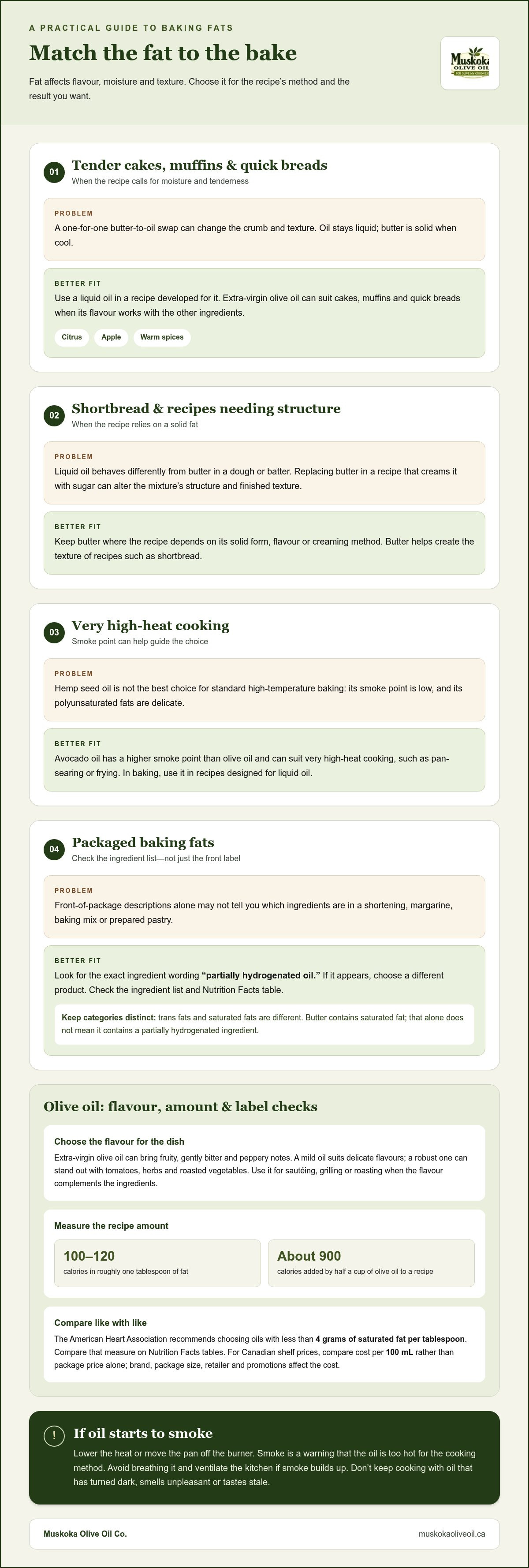
Hemp seed oil isn’t the best choice for standard high-temperature baking: its smoke point is low, and its polyunsaturated fats are delicate. For healthy baking fats, match the fat to the recipe. Liquid oils, such as olive oil, suit tender cakes, muffins and quick breads, while butter adds flavour and structure to recipes that rely on a solid fat.
Choosing a baking fat isn’t only about nutrition. The fat affects flavour, moisture and texture, so an automatic one-for-one swap can change how a recipe turns out. You’ll learn where olive oil, avocado oil and butter work best, why hemp seed oil is better suited to other uses, and what to avoid when choosing cooking fats.
Smoke point can help guide your choice for higher-heat cooking, while partially hydrogenated oils and trans fats are worth avoiding. Match the fat to the job, and you can bake with confidence and enjoy the results.
Key Takeaways
- Match the fat to the bake: liquid oils can suit tender cakes and muffins, while butter helps create the texture of recipes such as shortbread.
- Hemp seed oil is better suited to no-bake treats or finishing than standard high-temperature baking.
- Use avocado oil when a recipe calls for a fat suited to higher-heat cooking, and consider flavour as well as heat when choosing an oil.
- Check ingredient labels and avoid oils containing partially hydrogenated oils or trans fats.
- Discover how infused olive oil can bring a distinctive flavour to everyday cooking and baking.
1. Extra-virgin olive oil for cooking
Extra-virgin olive oil brings fruity, gently bitter and peppery notes to savoury cooking. Use it to sauté vegetables, grill or roast when its flavour complements the ingredients. A mild oil suits delicate flavours; a robust one stands out with tomatoes, herbs and roasted vegetables. Choosing healthy baking fats also means considering flavour, since the oil can be noticeable in the finished dish.
The American Heart Association recommends choosing oils with less than 4 grams of saturated fat per tablespoon. Compare that measure on the Nutrition Facts table when selecting a cooking oil. A tablespoon of fat contains roughly 100 to 120 calories, and half a cup of olive oil adds about 900 calories to a recipe. Measure the amount your recipe needs.
Extra-virgin olive oil can work in baking when a recipe needs moisture and tenderness. Try it in a cake, muffin or quick bread where its flavour suits the other ingredients. For instance, olive oil can complement citrus, apple or warm spices. Start with a recipe written for liquid oil, since an automatic swap for butter may change the texture.
Butter, olive oil, canola oil, avocado oil and coconut oil differ in their fat profiles and physical forms. Butter is a solid dairy fat; the oils are liquid. Their proportions of saturated, monounsaturated and polyunsaturated fats vary. Check each product’s Nutrition Facts table for amounts per serving. A thoughtful choice of healthy baking fats considers both the recipe’s texture and the oil’s nutrition information.
There isn’t one fixed Canadian price ranking for these fats. Brand, package size, retailer and promotions affect shelf prices, so compare the cost per 100 mL in Canadian dollars. Canola oil may suit a value-focused shop, but the best buy depends on specific products and package sizes. Compare like with like rather than judging by package price alone.
Keep the recipe’s structure in mind. Fat contributes tenderness and texture, so removing it without adjusting other ingredients can change the result. A recipe developed for liquid oil generally gives a more reliable outcome than an untested butter-to-oil substitution. For a new olive-oil bake, follow the stated quantity, then note the flavour and crumb.
- Use extra-virgin olive oil for sautéing, grilling and roasting when its flavour fits.
- Choose liquid oil for tender cakes, muffins and quick breads designed for it.
- Compare saturated fat on Nutrition Facts tables and measure oil into recipes.
- Compare Canadian shelf prices per 100 mL, not package prices alone.
2. Avocado oil for high-heat cooking and baking
Avocado oil has a higher smoke point than olive oil, making it suitable for very high-heat cooking. That can make it useful for pan-searing or frying, where a pan gets hotter than it would for gentle sautéing. Choose it when the cooking method calls for sustained heat and a neutral-tasting oil won’t compete with the food’s flavour.
For a skillet meal, prepare the ingredients first, then heat the pan and add the oil before cooking. Stay nearby and watch for smoke. If the oil begins to smoke, lower the heat or move the pan off the burner. A smoking pan signals that the oil is too hot for the cooking method.
Repeatedly heating or overheating cooking oil can degrade its quality and change its flavour. Smoke is a practical warning to stop heating the oil. Avoid breathing it and ventilate the kitchen if smoke builds up. Don’t keep cooking with oil that has turned dark, smells unpleasant or tastes stale.
Avocado oil can also work in baking when a recipe calls for liquid oil. Its mild taste suits a simple loaf cake or savoury quick bread where a pronounced olive flavour might not fit. Follow the recipe’s stated amount and method. Baking relies on the balance of fat, flour and other ingredients, so an untested swap can affect tenderness and crumb.
Consider the recipe before replacing butter with avocado oil. Butter is solid when cool, while avocado oil remains liquid, so they behave differently in doughs and batters. In a cake designed for oil, use the stated amount. In a recipe that creams butter with sugar, switching to liquid oil can alter the mixture’s structure and finished texture.
Smoke point matters most when fat is exposed to high heat, but it doesn’t determine every baking choice. In the oven, the recipe’s structure, flavour and required fat form matter too. Read the method before choosing an oil, then match it to the result: avocado oil for high-heat cooking, or a recipe-tested liquid oil for baking.
- Choose avocado oil when a dish needs very high-heat cooking.
- Prepare ingredients before heating the pan, and watch for smoke.
- For baking, use avocado oil in recipes designed for liquid fat.
- Keep butter in recipes that depend on creaming or solid-fat structure.
3. Avoiding partially hydrogenated oils and trans fats
Make the ingredient list part of choosing a packaged baking fat. Look for the exact wording “partially hydrogenated oil” on shortening, margarine, baking mixes and prepared pastry. If it appears, choose a different product. Checking both the ingredient list and Nutrition Facts table gives you a clearer picture than relying on front-of-package descriptions alone.
Trans fats and saturated fats are different categories, so don’t use the terms interchangeably. Butter, for example, contains saturated fat; that alone doesn’t mean it contains a partially hydrogenated ingredient. Read the label for the specific ingredient and compare similar products. This is more precise than rejecting every packaged fat or assuming all solid fats have the same composition.
For Canadian nutrition choices, a cautious approach is to favour unsaturated oils when a recipe works well with liquid fat. The recipe still matters: liquid oil may suit a cake developed for oil, while a packaged fat may be formulated for a particular pastry or dough. Choose a product whose ingredients and form suit the bake, rather than making a substitution based on one label detail.
Use a simple check while shopping. First, scan the ingredient list for “partially hydrogenated oil.” Next, compare the Nutrition Facts tables of similar products. Then consider how you’ll use the fat: a neutral liquid oil can suit a plain cake, while a solid baking fat may be needed for a specific dough. This keeps label reading practical and tied to the recipe.
Packaged foods can contain fats in unexpected places. Check the label on a pie shell, biscuit mix or ready-made frosting, even if you’re adding only a small amount to a homemade dessert. When baking from scratch, choose ingredients individually and follow a recipe written for the fat you plan to use. This helps you avoid unwanted ingredients without changing the bake blindly.
Compare products thoughtfully, not by a single package claim. “Vegetable oil” describes a broad category, so check the ingredient list to see which oil is used. If the label names partially hydrogenated oil, choose another option. For the rest, let the recipe, flavour and fat form guide you. These steps help you avoid partially hydrogenated oils and trans fats while keeping the finished bake in view.
- Scan packaged baking ingredients for “partially hydrogenated oil.”
- Compare ingredient lists and Nutrition Facts tables across similar products.
- Choose an oil suited to the recipe’s method and finished texture.
- Check ready-made pastry, mixes and frostings, not just stand-alone fats.
4. Butter for flavour and richness
Butter brings a creamy, dairy flavour that can define a bake, from classic shortbread to chocolate chip cookies. Its solid form matters too: creaming softened butter with sugar traps air and helps create a lighter texture. Follow the recipe’s temperature instructions. Butter that’s too cold won’t cream smoothly, while melted butter produces a different result.
In pastry and biscuits, solid butter helps shape the texture. As butter melts in the oven, its water content creates steam, while the fat adds tenderness and richness. That’s why liquid oil isn’t a direct replacement in recipes such as shortbread, pastry and biscuits that rely on solid butter. Choose a recipe developed for oil if you want to bake with a liquid fat.
Butter’s flavour also affects how other ingredients come through. In a plain butter cookie, its dairy notes are central; in a spiced loaf, they round out cinnamon or ginger. For a more pronounced toasted flavour, brown butter gently in a saucepan, stirring as the milk solids turn golden. Let it cool as the recipe directs before mixing.
Whipped butter has about half the calories per tablespoon of regular butter, but its airy structure means it doesn’t measure or behave like a solid block. Use the type of butter specified in the recipe rather than substituting whipped butter by volume. Accurate measuring helps preserve the intended balance of fat, flour and liquid.
Ghee is clarified butter, made by removing the milk solids. It has a concentrated buttery character and a different composition from regular butter; ghee contains less than 1% lactose. For a recipe that relies on butter’s solid texture, remember that ghee’s form and moisture differ. Choose a recipe that specifically uses ghee when those differences matter.
Keep butter chilled until you’re ready to prepare a recipe that calls for softened or cold butter. For a pie crust, cut cold butter into flour as directed, leaving visible pieces for a flaky result. For cookie dough, soften the butter enough to cream, then mix it with sugar before adding the remaining ingredients. These steps help the fat perform as intended.
- Use softened butter for recipes that begin by creaming butter and sugar.
- Keep butter cold for pastry recipes that call for cutting it into flour.
- Choose a recipe designed for liquid oil instead of swapping oil directly into shortbread or biscuits.
- Follow the recipe’s specified butter type, especially when it distinguishes regular from whipped butter.
5. What is the smoke point of common baking fats?
A fat’s smoke point is the temperature at which it begins producing visible smoke. Avocado oil has a higher smoke point than olive oil, so it suits very high-heat cooking. Smoke point varies with an oil’s refining and condition, so one number won’t describe every bottle. Consider the label and cooking method together when choosing a fat.
In baking, the oven setting doesn’t automatically mean the oil reaches that same temperature. Moisture in a batter or dough affects how heat moves through the food. For example, cake batter containing olive oil behaves differently from oil heated alone in a skillet. Match the fat to the recipe, then watch for smoke during any stovetop preparation.
Avocado oil is useful for very high-heat cooking, such as pan-searing, and can also work in recipes that call for liquid oil. Canola oil is another option for baking and high-heat cooking. For a cake or quick bread, choose a recipe written for liquid fat; for high-heat cooking, consider the pan temperature and the oil’s condition.
Olive oil can suit sautéing, grilling and baking, but its flavour and smoke point differ from avocado oil. Extra-virgin olive oil has a more pronounced flavour than a neutral oil, which may complement a savoury loaf or clash with a delicate cake. For baking, use an oil-based recipe that accounts for its liquid texture and flavour.
Hemp seed oil isn’t the best choice for standard high-temperature baking. Its smoke point is low, and its polyunsaturated fats are delicate. Reserve it for no-bake desserts, smoothies, dips, dressings or a drizzle after cooking. This keeps hemp seed oil away from heat that doesn’t suit it.
Butter behaves differently from liquid oils. Its milk solids can brown during cooking and add flavour, while excessive heat can scorch them. Ghee is clarified butter without milk solids, so it behaves differently from regular butter. For baking, use the fat specified in the recipe; smoke point alone won’t predict whether a swap preserves texture.
Repeated heating or overheating can degrade cooking oil and affect its flavour. Don’t leave a pan of oil heating unattended, and lower the heat if smoke appears. Discard oil that smells unpleasant or tastes stale rather than using it again. These practical cues matter more than memorizing a temperature chart for every fat.
- Choose avocado oil for very high-heat cooking.
- Use canola oil in recipes designed for liquid fat or high-heat cooking.
- Keep hemp seed oil for no-bake uses or finishing dishes.
- Watch the pan for smoke, and lower the heat if it appears.
Muskoka Olive Oil Co.: Infused Olive Oil
Muskoka Olive Oil Co. offers infused olive oil for cooks who want to add distinct flavour to everyday dishes. Once you’ve chosen a fat to suit the recipe’s texture and cooking method, infused oil can add another layer of flavour to savoury baking or finishing touches. For example, use a flavoured oil when its taste complements herbs, vegetables or a savoury loaf, rather than swapping it into a delicate sweet bake without considering the result.
Explore the infused olive oil selection to find options for your kitchen and flavour preferences. Visit muskokaoliveoil.ca to discover infused olive oil for your next recipe.
Make your next bake a small experiment
Choose a recipe you know well, then make a considered change instead of replacing every fat in your pantry at once. A savoury loaf, for example, gives you room to explore how an oil’s flavour works with herbs or vegetables. Note the ingredient, amount and result, then use those observations to refine future bakes. This practical habit makes choosing healthy baking fats less about rigid rules and more about matching flavour, texture and recipe design.
For a fresh flavour direction, Muskoka Olive Oil Co. offers Extra Virgin Olive Oil and Infused Olive Oil, alongside White Balsamic Vinegars. Consider how each might complement a dish, whether you’re baking or preparing something to serve alongside it. A new ingredient can inspire a different pairing without requiring a complete recipe overhaul.
Ready to explore oils for your kitchen? Contact Muskoka Olive Oil Co. and discover an ingredient that suits your next cooking idea. Let your next recipe be a delicious opportunity to learn.
FAQs
Can You Bake With Hemp Seed Oil?
Yes, hemp seed oil can add its distinctive taste to no-bake recipes and finishing touches. Try it in a chilled dessert filling or whisk a little into a dressing served with a savoury tart. Its flavour may stand out, so consider whether it complements ingredients such as cocoa, fruit or herbs. Keep the recipe’s flavour profile in mind, not just the type of fat it calls for.
Can You Replace Butter With Oil in Baking?
Sometimes, but the outcome depends on how the recipe uses butter. In a cake, the mixing method can affect the crumb; in cookies, creaming butter with sugar incorporates air. If you want to experiment, choose a recipe specifically written for oil and compare the result with your usual version. This gives you a useful reference for flavour and texture without changing several ingredients at once.
Which fats are considered healthy for baking?
No single fat is the best choice for every bake. Consider the recipe’s purpose, the fat’s flavour and the nutrition information on its label. For example, a mild oil may suit a delicate cake, while a more flavourful oil can complement a savoury loaf. Think of fat as one ingredient in the overall recipe, rather than judging a finished food by its fat alone.
Can butter or oil be substituted for one another in baking, and in what ratios?
There isn’t one reliable ratio for every recipe. Butter and oil differ in composition and behaviour during mixing, so a conversion that works for one cake may not suit pastry. Check whether the recipe gives a specific substitution. If it doesn’t, choose a tested recipe made with your preferred fat instead of calculating a general swap. This also helps preserve the intended flavour and crumb.
Are seed oils safe and healthy to use in baking?
Seed oils can be used in baking, but their flavour and properties vary by type. Canola oil, for example, is useful in baking, while a strongly flavoured oil may change the taste of a delicate cake. Check the ingredient list and nutrition information, and store oils in a cool, dark place. Choose an oil that suits the recipe rather than treating all seed oils as identical.
How do butter, olive oil, canola oil, avocado oil, and coconut oil compare nutritionally?
Their fat profiles differ, and butter is a solid dairy fat while the oils are liquid. Coconut oil is high in saturated fat; compare Nutrition Facts tables and choose oils with less than 4 grams of saturated fat per tablespoon.
Which baking fats are most affordable in Canada, and what do they cost?
There is no fixed Canadian price ranking. Canola oil may suit a value-focused shop, but prices vary by brand, package size, retailer and promotions; compare the cost per 100 mL in Canadian dollars.
Leave a comment